
Franciszek Wierusz-Kowalski – Knight of Malta. Lecture by Dr Tadeusz Wojciech Lange
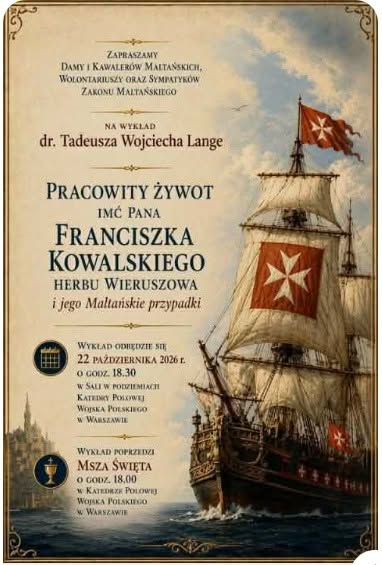
On 22 October 2026, a lecture by Dr Tadeusz Wojciech Lange on Franciszek Wierusz-Kowalski of the Wieruszowa coat of arms, courtier to the Sobieski family and Knight of Malta, will take place at the Field Cathedral of the Polish Army in Warsaw. The speaker, a historian and expert on the history of the Order of Malta, will present Franciszek's remarkable life, his service at the royal court and his Maltese adventures. The Alfred Wierusz-Kowalski Foundation warmly invites you to attend the meeting, which will allow you to discover a little-known chapter in the history of our family.
SPEAKER:
Dr Tadeusz Wojciech Lange (born 1952 in Zielona Góra) is a Polish historian, English-language and Scandinavian studies scholar, specialising in the history of the Order of Malta, its structures and its activity in Polish lands. He is a retired teaching staff member of Adam Mickiewicz University in Poznań. He obtained his doctorate in history. His academic interests also include heraldry, the history of weaponry and the Polish cavalry. He is a member of the Polish Heraldic Society and the Society of Enthusiasts of Historical Arms and Colours. For his services he was awarded by the Order of Malta the Officer's Cross of the Order pro Merito Melitensi
twlange-publikacje.web.amu.edu.pl
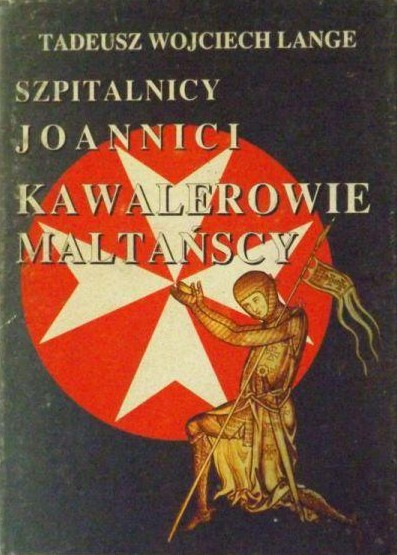
Most important publications
- Szpitalnicy, joannici, kawalerowie maltańscy – 1994, second edition 1999. - Zakon Maltański w Drugiej Rzeczypospolitej 1919–1939 – 2000. - Przeoraty – baliwaty – komandorie. Zakon św. Jana Jerozolimskiego i jego placówki na terenie Polski – 2021. - Komandoria joannitów w Poznaniu i inne posiadłości zakonu w historycznej Wielkopolsce – 2024.
KNIGHTS OF MALTA - FRANCISZEK WIERUSZ-KOWALSKI (c. 1675–1742)
The Knights of Malta were members of one of the oldest chivalric orders in the world, whose origins reach back to the 11th century and the activity of the hospital of St John the Baptist in Jerusalem. Initially, their task was to care for the sick and for pilgrims arriving in the Holy Land. In time the order also took on a military character, and its knights took part in defending Christian pilgrims and the order's possessions. After the loss of the Holy Land, the Hospitallers moved their seat to Cyprus, then to Rhodes, and in 1530 to Malta, from which their present-day name derives. The Knights of Malta came most often from European noble families, and admission to the order required, in many of its categories, proof of suitable descent. Their characteristic symbol became the white eight-pointed Maltese cross, displayed on the order's garments, banners and ships. In the 16th and 17th centuries the order's fleet played a significant role in naval warfare in the Mediterranean, above all against the Ottoman Empire and the North African corsairs. Members of the order took part in naval expeditions known as caravans, which formed an important part of their preparation for chivalric service. Among the Polish Knights of Malta was Franciszek Wierusz-Kowalski (c. 1675–1742), a courtier of Queen Marie Casimire Sobieska, whose fortunes became bound up with Malta at the beginning of the 18th century. Today the Sovereign Order of Malta continues this centuries-old tradition, focusing its work on humanitarian aid, medical care and support for the sick and needy around the world.
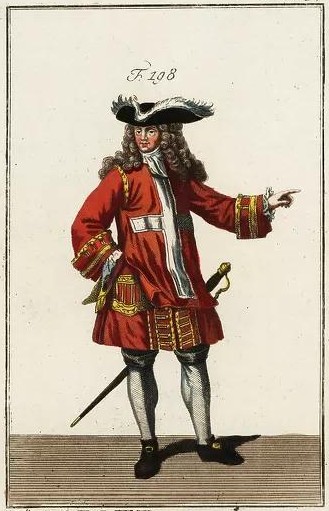
Franciszek Wierusz-Kowalski, Knight of Malta, courtier of the Sobieskis and European traveller - the chapter devoted to Franciszek from the forthcoming publication "The Wierusz-Kowalskis: Selected Figures", by Rafał Wierusz-Kowalski
Franciszek Wierusz-Kowalski was one of those members of the family whose lives took them far beyond the borders of the Polish-Lithuanian Commonwealth and linked them with the most important European courts of the early 18th century. As a courtier of Marie Casimire Sobieska, and later a knight of the Order of Malta, he moved in circles of aristocrats, diplomats and clergymen. His biography is an interesting example of the career of a Polish nobleman who, thanks to family connections, education and his own abilities, found a place in the world of the European elites.
FAMILY ROOTS
Franciszek Wierusz-Kowalski was born around 1675, probably in Borzykowa in the Sieradz region. He was the son of Jan Wierusz-Kowalski and Anna née Kobielska. He lost his father at a young age, and so his further education and career were taken in hand by relatives. A particular role was probably played by his paternal uncle, Fr Stanisław Konstanty Wierusz-Kowalski, a canon of Warmia, who had influence in church and court circles.¹
Although little is known about Franciszek's childhood, it may be assumed that he received a careful education. In later life he moved with ease among the European elites, which required a knowledge of foreign languages, the principles of diplomacy and court culture.
IN THE SERVICE OF QUEEN MARIE CASIMIRE
A turning point in his life was his association with the Sobieski family. After the death of King John III Sobieski in 1696, he remained in the entourage of the king's widow, Queen Marie Casimire, commonly known as Marysieńka.
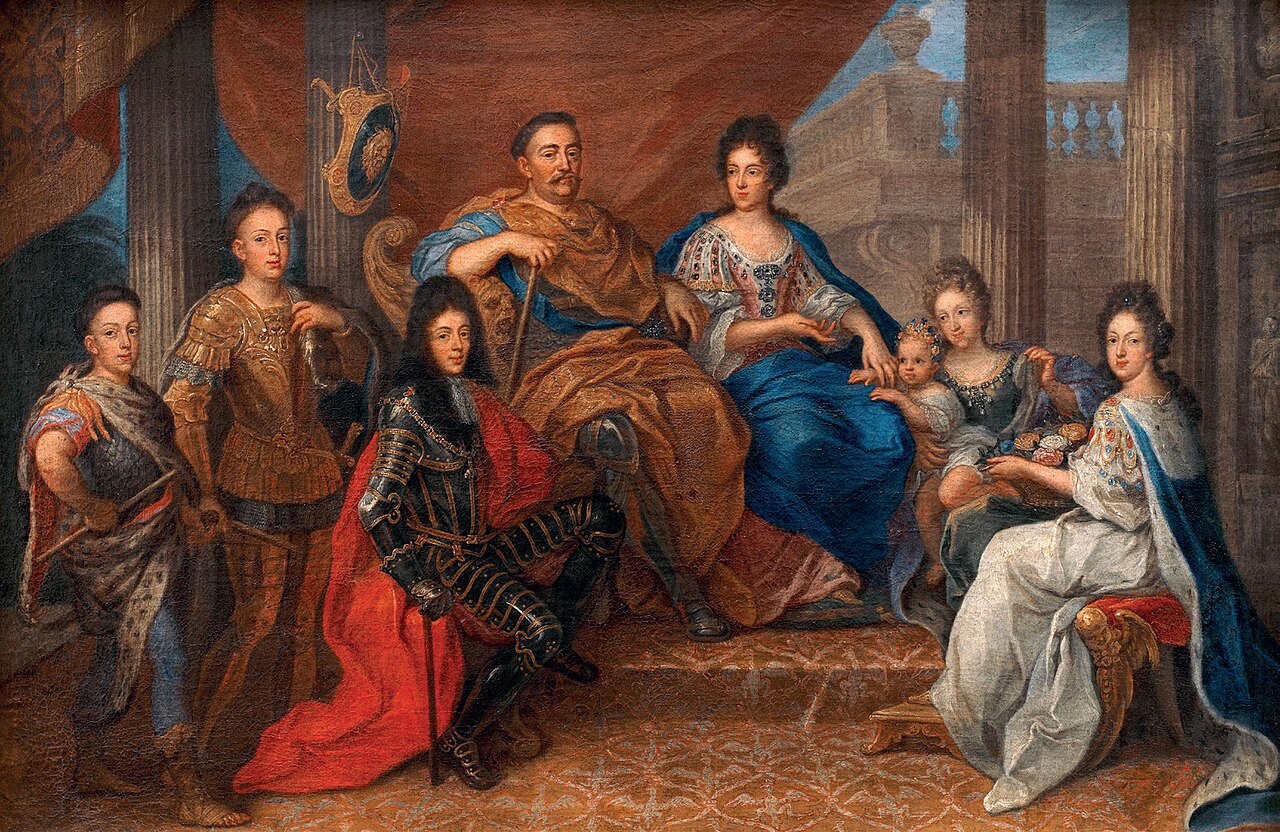
In 1698 the queen left the Commonwealth and went to Rome. Franciszek was among those who accompanied her on this journey. The queen's stay in Italy lasted many years, and her court became an important centre of Polish political and cultural émigré life. Franciszek was one of Marie Casimire's trusted associates. He dealt with organisational matters, contacts with the Polish nobility and the administration of the queen's estate.²
During his stay in Rome he gained valuable experience and made numerous acquaintances. He also took part in the life of the Polish community gathered around the Church of St Stanislaus, which served as the religious and social centre for Poles living in the Eternal City.
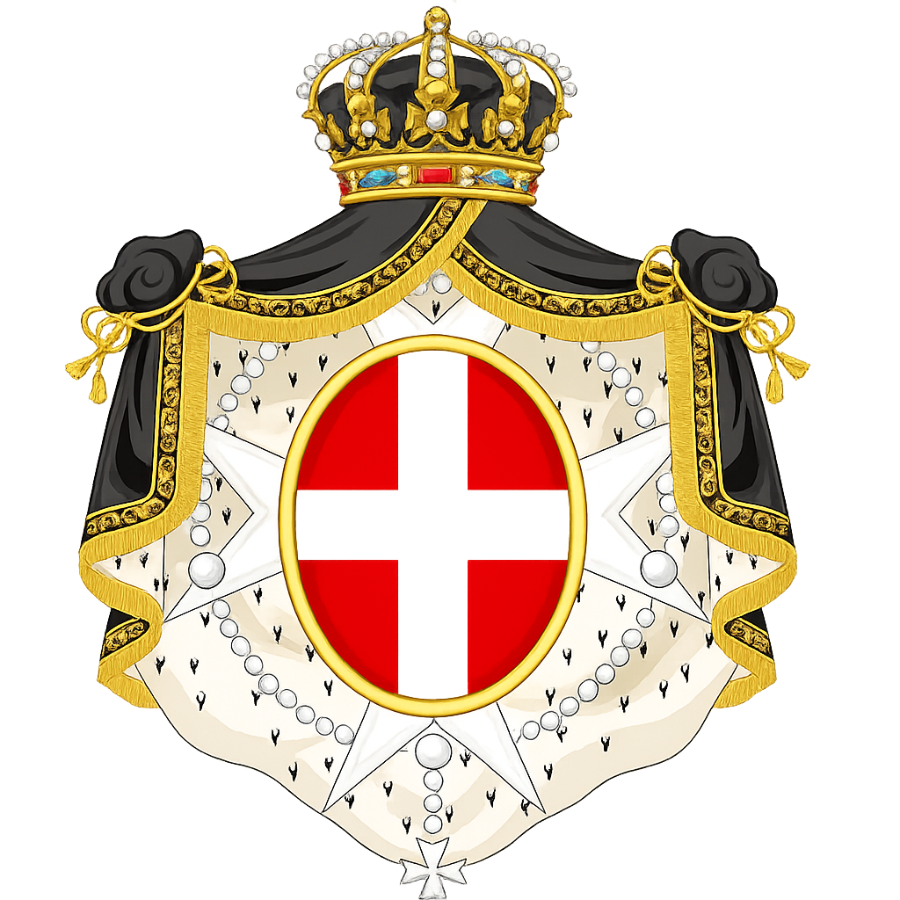
THE MALTESE CHAPTER OF HIS LIFE
The most fascinating stage of Franciszek's biography was his association with the Order of Malta, that is, the Order of the Knights Hospitaller of St John of Jerusalem. In the 18th century it was among the most prestigious chivalric orders in Europe and brought together representatives of distinguished noble families.
Franciszek was admitted to the order probably around 1710. In documents from 1716 he already appears as a Knight of Malta. This meant not only prestige, but also specific obligations towards the religious community.³
His stay in Malta allowed him to come into contact with an international milieu of aristocracy and military men. The island was then an important strategic point in the Mediterranean, and the order maintained extensive political and commercial contacts.
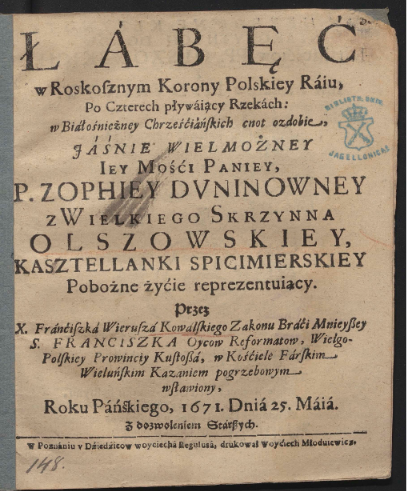
Source: Wielkopolska Digital Library
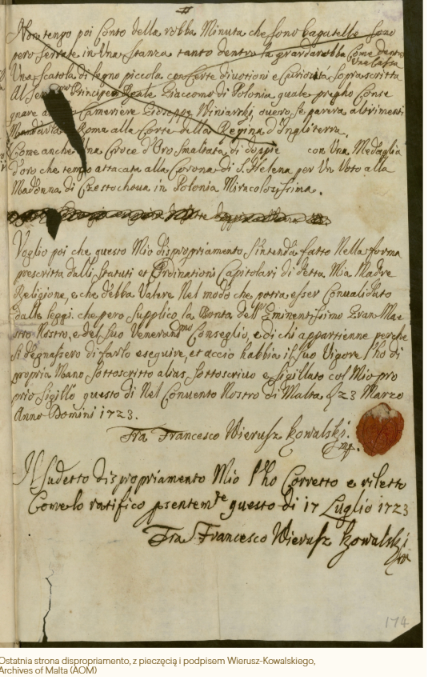
THE SURVIVING WILL OF A KNIGHT OF MALTA
One of the most valuable sources concerning Franciszek is a document preserved in the Maltese archives, referred to as a dispropriamento. It was a kind of declaration of property drawn up by the knights of the order, among other occasions before taking part in naval expeditions.⁴
The document contains information about Franciszek, his family, his property, and his religious obligations and foundations. Its discovery has allowed historians to reconstruct the Maltese period of Wierusz-Kowalski's life in more detail and to supplement information previously known from scattered sources.
Acknowledgements
I would like to offer particular thanks to Fr Dr Jacek Kapuściński, author of a detailed study devoted to Franciszek Wierusz-Kowalski, whose research has made it possible to reconstruct far more precisely his origins, his ties with the Sobieski family and the course of his court service. I also thank Tadeusz Wojciech Lange for his study of Franciszek's Maltese period and for presenting the documents preserved in the archives of the Order of Malta.
Notes
1. Jacek Kapuściński, "Kawaler maltański Franciszek Wierusz-Kowalski herbu Wieruszowa (ok. 1675–1742) w służbie królewskiej rodziny Sobieskich" [Knight of Malta Franciszek Wierusz-Kowalski of the Wieruszowa coat of arms (c. 1675–1742) in the service of the royal Sobieski family], Studia Polonijne, vol. 43, Lublin 2022, pp. 275–294.
2. Jarosław Pietrzak, "Rzymski dwór Marii Kazimiery d'Arquien Sobieskiej w latach 1699–1714 w świetle metrykaliów i danych źródłowo-biograficznych" [The Roman court of Marie Casimire d'Arquien Sobieska in the years 1699–1714 in the light of registers and source-biographical data], in: Dwór kobiecy w Rzeczypospolitej XVII i XVIII wieku, ed. Bożena Popiołek, Anna Penkała-Jastrzębska, Klaudia Pyzel, Kraków 2021, pp. 33–85.
3. Tadeusz Wojciech Lange, "Maltański epizod Franciszka Wierusz-Kowalskiego, dworzanina Sobieskich" [The Maltese episode of Franciszek Wierusz-Kowalski, courtier of the Sobieskis], Museum of the Palace of King John III in Wilanów, 2024.
4. Archives of the Order of Malta, AOM 931 (43), Item no. 1, ff. 171r–174r.