
Munich School
THE MUNICH SCHOOL – POLISH PAINTERS IN THE CAPITAL OF BAVARIA
Munich – the city where Polish artists won European fame
In the second half of the 19th century, Munich became one of the most important artistic centres in Europe. It attracted painters from many countries, offering excellent conditions for study, a well-developed art market and the opportunity to gain international recognition. Poles held a special place in this milieu, forming one of its most recognisable artistic groups. Among them were Józef Brandt, Alfred Wierusz-Kowalski, Józef Chełmoński, Maksymilian and Aleksander Gierymski, Władysław Czachórski, Antoni Kozakiewicz and many other artists.¹
The term Munich school did not denote a single academy or a uniform painterly movement. It referred to the community of artists who trained and worked in Munich, united by their academic experience, interest in realism, care for craftsmanship and mutual artistic contacts.
WHY MUNICH?
The rise of Munich as a European capital of art was the result of the deliberate policy of the Bavarian rulers, especially King Ludwig I of the Wittelsbach dynasty. In the first half of the 19th century he began transforming the city into a major centre of culture and learning, investing in museums, galleries, architecture and artistic education.¹
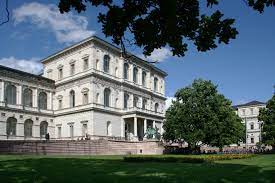
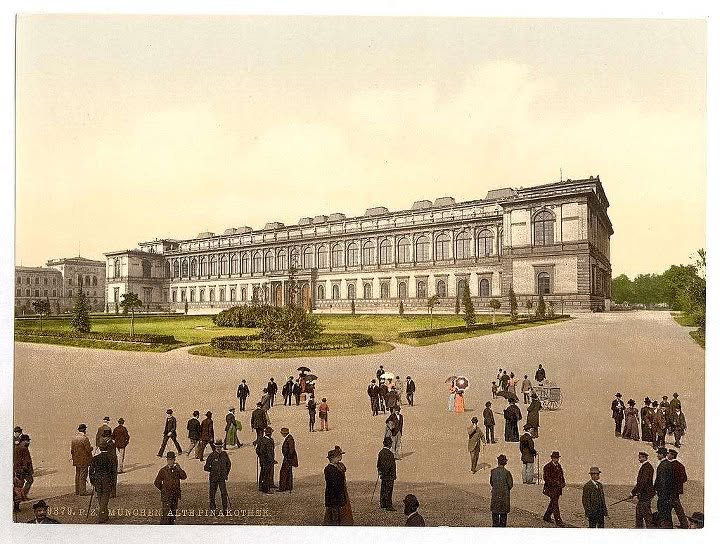
Institutions were established that remain among the most important museums in Europe today: the Old Pinakothek (Alte Pinakothek), the New Pinakothek (Neue Pinakothek) and the Glyptothek. There, artists could study the works of the old masters and become acquainted with the greatest achievements of European painting.
The heart of the artistic community was the Royal Academy of Fine Arts, founded in 1808. The academy employed outstanding teachers and attracted students from all over Europe.
The work of Professor Carl Theodor von Piloty was of particular importance; he emphasised realism of depiction, historical precision and the ability to build elaborate compositions.
Munich, however, offered much more than education alone. The city had a well-developed art market, numerous galleries, trading houses and collectors ready to buy paintings. The studios of established painters were visited by representatives of the aristocracy, wealthy townspeople and foreign art lovers.²
POLES IN MUNICH
The first Polish artists appeared in Munich as early as the first half of the 19th century, but the Polish community grew most after the January Uprising of 1863.
The defeat of the uprising, Russian repression and limited opportunities for artistic development at home led many young Poles to seek the chance to study and work abroad. Munich became one of their most important destinations.
According to data cited by the art historian Dr Beata Skrzydlewska, about six hundred Polish painters passed through the Munich artistic community in the 19th century. Not all of them stayed there permanently. For some it was a period of several years of study, while for others the city became a place of long-term work and life.¹
The Poles formed a close-knit community. They met in studios, restaurants and cafés, studied together, organised exhibitions and helped one another to obtain commissions.
The presence of artists who had already won recognition on the European art market was particularly important. Younger painters could draw on their experience, contacts and advice.
JÓZEF BRANDT – THE UNOFFICIAL LEADER OF THE POLISH MUNICH PAINTERS
One of the most important figures of the Polish community was Józef Brandt (1841–1915), who arrived in Munich in 1862.
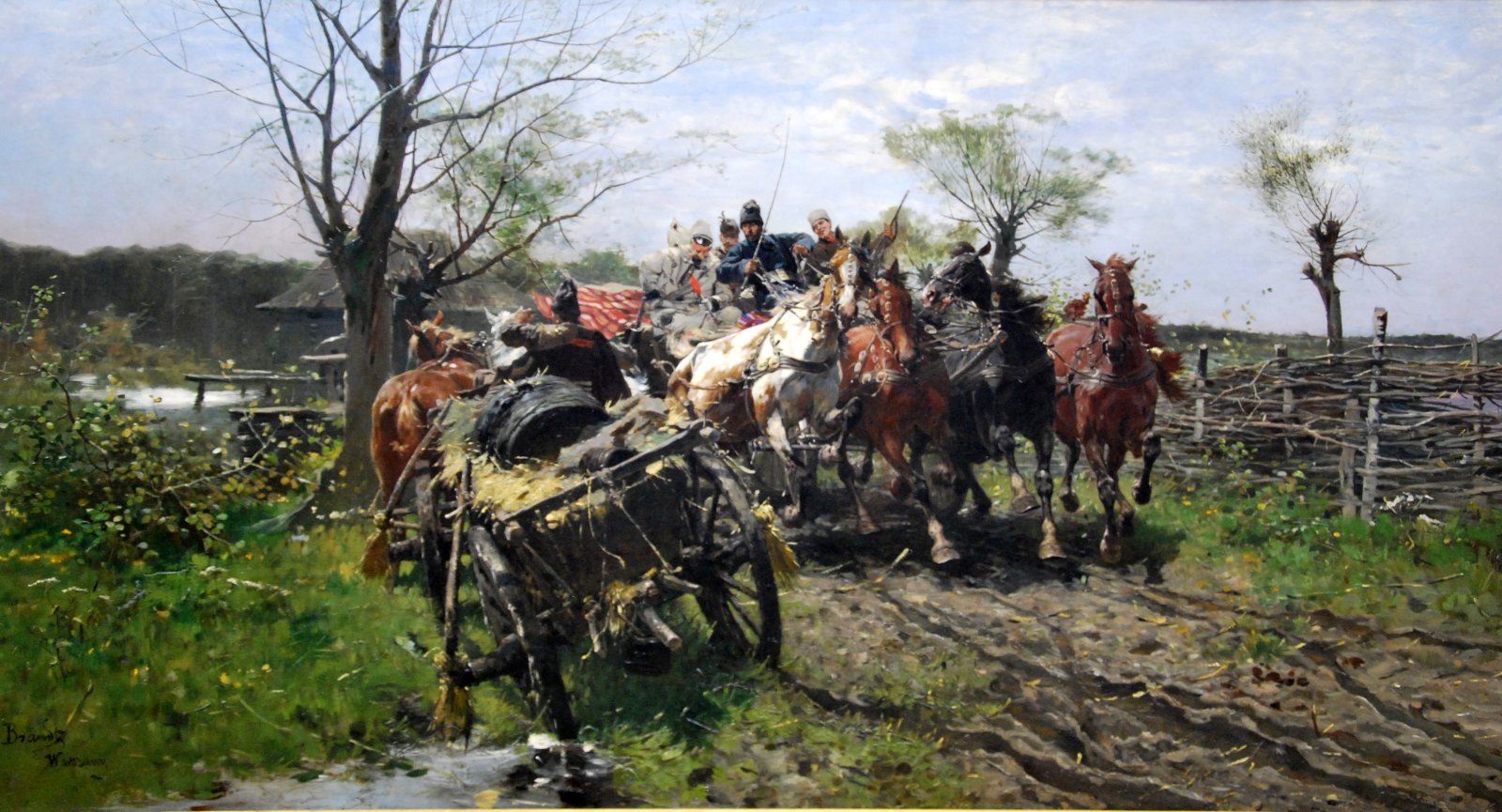
Brandt won fame as a painter of battle, historical and genre scenes, especially those connected with the history of the old Polish-Lithuanian Commonwealth. His paintings attracted enormous interest from collectors, and his studio became one of the most important meeting places for Polish artists.³
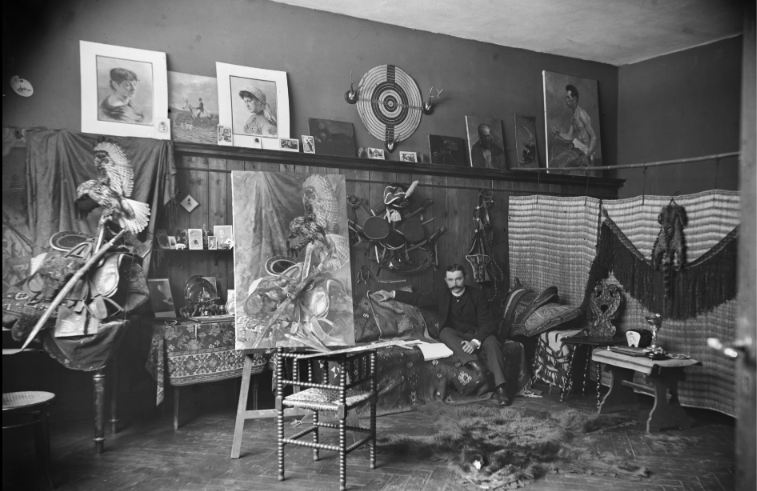
Brandt's atelier at Schwanthalerstraße 19 served at once as a workshop, a gallery, a social salon and a place of informal education.
He gathered there a rich collection of antique weapons, armour, costumes, saddles and other historical objects. He used these props when preparing his paintings, taking care over the credibility of the scenes depicted.
Brandt also helped his younger compatriots, giving them advice, making his studio available to them and introducing them to the artistic community.
Among those who developed in his circle were Alfred Wierusz-Kowalski, Antoni Kozakiewicz, Tadeusz Ajdukiewicz, Władysław Szerner and other Polish artists.
Illustrations:
EVERYDAY LIFE OF THE POLISH ARTISTIC COLONY
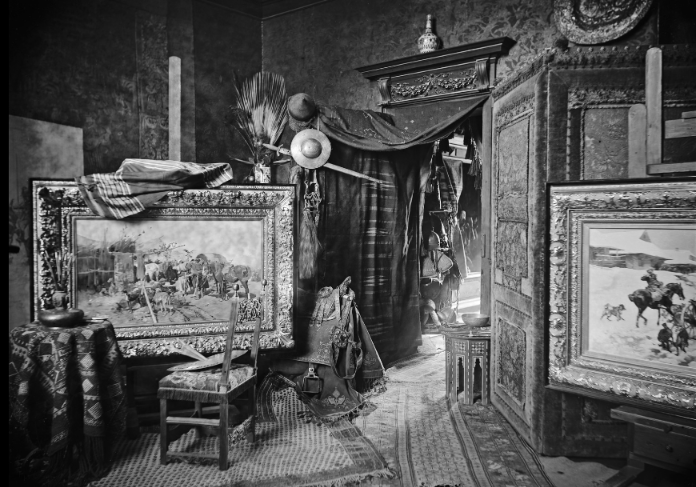
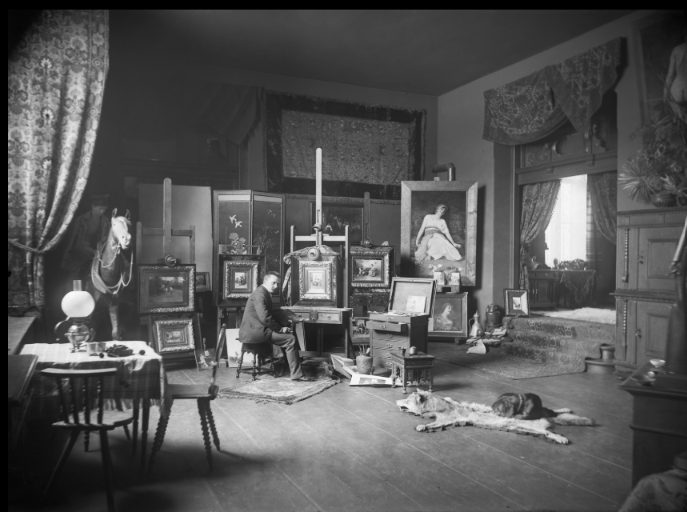
The Polish Munich painters formed a community with a lively social life. They met not only during academic classes but also in studios, cafés and restaurants.
One of the best-known meeting places was Café Tambosi on Odeonsplatz. Artists went there to talk, rest, play billiards and discuss art.
Juliusz Kossak's recollections of his stay in Munich in 1868–1869 show that after the day's work the painters often met in Brandt's studio. They talked, made music, joked and spent their evenings together.³
The life of the Polish painters was not limited to social gatherings, however. It was also a time of intense work, rivalry and the search for buyers for their paintings.
Not all artists achieved financial success. Young students often rented modest studios, which served them at once as a workplace and a home. Only once they had won recognition could they set up a larger atelier and employ assistants.
PAINTERS' STUDIOS – WORKSHOPS AND SALONS
A distinctive feature of the Munich community was its stately artists' studios, which played a far greater role than ordinary rooms intended for painting.
The studios of established artists contained paintings, antique furniture, fabrics, carpets, weapons, historical costumes and numerous props. These interiors were meant to testify to the owner's standing and to create a suitable atmosphere during visits from collectors.
Studios were also an important element of the art market. They were visited by potential buyers, critics and representatives of the aristocracy. In some cases, special tours of the ateliers of well-known painters were even organised.²
A valuable record of this world is the photographs by Carl Teufel (1845–1912), who at the end of the 19th century took hundreds of pictures of Munich artists' studios.
Surviving photographs include, among others, the ateliers of Józef Brandt, Władysław Czachórski, Antoni Kozakiewicz, Franciszek Ejsmond and Alfred Wierusz-Kowalski.https://www.porta-polonica.de/en/atlas-of-remembrance-places/ateliers-polish-painters-munich-ca-1890
They show not only the painters' working conditions but also their social standing, taste and the way they presented their own work.²
ALFRED WIERUSZ-KOWALSKI – ONE OF THE MOST EMINENT MUNICH PAINTERS
Alfred Wierusz-Kowalski (1849–1915) came to Munich after earlier studies in Warsaw, Dresden and Prague. At first he remained under the influence of Józef Brandt, but in time he developed his own, easily recognisable painting style.⁴
His paintings depicting the Polish provinces, horse-drawn teams, winter scenes and wolf attacks gained enormous popularity in Europe and the United States.
Alfred achieved a high professional and financial position. His studio was among the most impressive ateliers of Polish artists in Munich.
Photographs taken by Carl Teufel around 1889 show an interior filled with paintings, sketches, fabrics, furniture and props. On one of the walls one can make out a monumental composition depicting a wolf attack.
The studio was both a place of intense work and a stately salon in which the painter received collectors, guests and representatives of the Munich art world.
Alfred won the recognition of the Bavarian authorities and of the academic community. He received the title of honorary professor of the Academy of Fine Arts in Munich.⁴
Despite his success, he did not lose contact with Poland. He maintained family ties, took part in exhibitions in Poland, and in 1896 acquired the Mikorzyn estate in Greater Poland, where his wife Jadwiga lived with their children.
THE MOST EMINENT POLISH PAINTERS OF THE MUNICH SCHOOL
The Polish Munich community was not uniform. It was made up of painters with different interests, temperaments and ways of depicting reality.
The most important included:
- Józef Brandt (1841–1915) – an outstanding painter of battle and historical scenes, organiser of the Polish artistic community in Munich.
- Alfred Wierusz-Kowalski (1849–1915) – known for dynamic genre scenes, horse-drawn teams, winter landscapes and depictions of wolf attacks.
- Maksymilian Gierymski (1846–1874) – one of the most outstanding Polish realists, creator of atmospheric landscapes and scenes of the uprising.
- Aleksander Gierymski (1850–1901) – a painter interested in the problems of light, colour and everyday life.
- Józef Chełmoński (1849–1914) – a painter of the Polish countryside and landscape, whose work also developed under the influence of his Munich experiences.
- Władysław Czachórski (1850–1911) – a esteemed portraitist and painter of elegant salon scenes, especially popular with wealthy clients.
- Antoni Kozakiewicz (1841–1929) – author of genre scenes, often depicting the everyday life of the inhabitants of the Polish provinces.
- Adam Chmielowski (1845–1916) – a painter and participant in the January Uprising, later Brother Albert, founder of the Albertine congregations.
- Juliusz Kossak (1824–1899) – an outstanding painter of horses and historical scenes, associated with the Munich community during his stay in Bavaria.
- Wojciech Kossak (1856–1942) – a battle painter who also trained in Munich.
The diversity of their work shows that the Munich school did not impose a single style. What they had in common was above all solid technical training, the ability to observe nature and an interest in the realistic depiction of the world.
THE POLISH MUNICH SCHOOL AND NATIONAL IDENTITY
For many Polish artists, Munich became a place where they could develop their art freely at a time when Poland remained under foreign partitions.
Although they lived and worked abroad, they often took up subjects connected with the history, landscape and traditions of their homeland. They depicted scenes from the life of the Polish countryside, historical events, insurgents, hunts, journeys and characteristic landscapes.
Their paintings found their way to foreign collectors, thanks to which Polish culture was present on the international art market.
This did not mean, however, that all the Munich painters took up exclusively national subjects. Many of them created portraits, salon scenes, European landscapes, still lifes and Orientalist compositions.
Thematic diversity was one of the most important features of this community.
THE SIGNIFICANCE OF THE MUNICH SCHOOL
The Munich school played a significant role in the development of Polish painting in the second half of the 19th century. Thanks to it, Polish artists could obtain a high-level education, become acquainted with the latest artistic trends and take part in the international art market.
Many of them achieved professional success, and their paintings found their way into the most important museum and private collections.
Munich also became a meeting place of two cultures – Polish and German. Artists living in exile preserved their bond with their homeland while taking part in European artistic life.
The legacy of the Polish Munich painters is present today in the collections of museums in Poland and abroad. Of particular importance are the collections of the National Museum in Warsaw, the National Museum in Kraków and the District Museum in Suwałki.
It is in Suwałki, the home town of Alfred Wierusz-Kowalski, that one of the most important displays devoted to his work and to the Polish Munich community is to be found.⁵
The Munich school remains one of the most significant phenomena in the history of 19th-century Polish art. Its representatives proved that even at a time when independence had been lost, Polish culture could develop, win recognition and occupy an important place in European artistic life.
NOTES
- 1. Interview with Dr Beata Skrzydlewska, Deputy Director of the National Museum in Lublin, art historian and curator of the exhibition Monachijczycy (The Munich Painters), transcript of a conversation on the development of Munich as an artistic centre, the history of the Polish Munich painters and the activity of their studios.
- 2. Hans-Günther Grützner, Ateliers of Polish Painters in Munich ca. 1890, Porta Polonica, a study of Munich painters' studios and of Carl Teufel's photographic documentation.
- Ibid.; information on Józef Brandt's studio at Schwanthalerstraße 19, the life of the Polish artistic community, meetings at Café Tambosi and the Album of Polish Painters of 1876.
- 3. Eliza Ptaszyńska, Alfred Wierusz-Kowalski, 2nd edn, Olszanica: Wydawnictwo Bosz, 2021.
- 4. District Museum in Suwałki, materials on the exhibitions Alfred Wierusz-Kowalski 1849–1915, Polish Munich Painting and The Munich of Alfred Wierusz-Kowalski.