
Auction of the painting "Wesoła Jazda" at Desa Unicum, Warsaw, 10 December 2026, 7:00 pm
Source of information and photograph: DESA UNICUM
oil on canvas (relined), 78 x 105.5 cm
signed lower right: 'A. W. Kowalski'
- collection of Jadwiga Juchniewicz, Lugano
- private collection
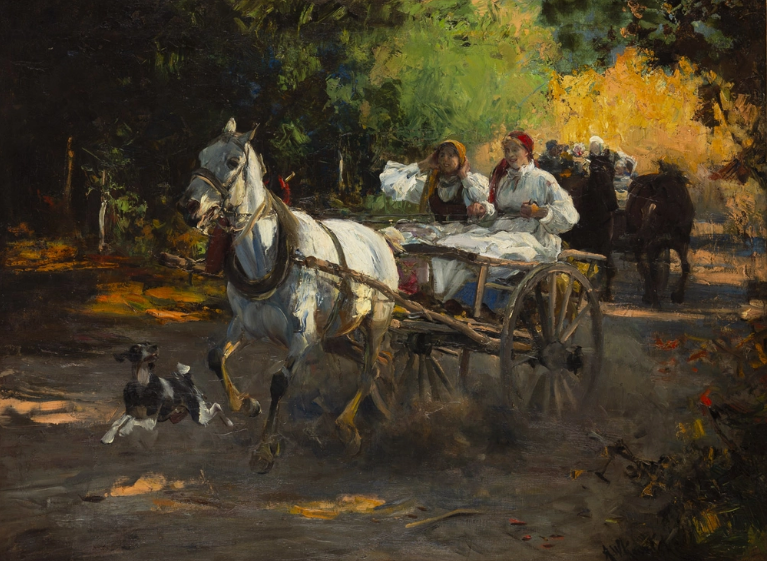
Although snow-covered winter landscapes predominated in the artist's painting, especially after 1900 he also created compositions in yellows, filled with dry summer air and enlivened by the intense colours of the figures' clothing, and the painting presented here is of just such a character. At the centre of the composition, two village girls are riding in a carriage drawn by a galloping horse. In the background a second carriage is visible, in which a larger group follows the first vehicle. The dynamism of the ride is emphasised by the artist through the clouds of dust rising from beneath the wheels and by the gesture of the woman in the foreground, who holds her headscarf on with her hands. The painting is striking in its dynamism while at the same time maintaining formal discipline. Warm ochres, yellows and browns dominate, and a cloud of grey dust veils the background on the right-hand side.
The work is characterised by an almost Impressionist freedom and dynamism of brushstroke, as well as an expressive texture, all so characteristic of the artist's late painting. Colourful not only in its palette but also in its picturesque arrangement and narrative nature, the painting radiates a native familiarity. The warm colours of the trees and leaves suggest a late-summer or autumn ride. The dust and powder rising from beneath the wheels also reinforces the sense of this time of year, as well as the painter's bravura in capturing movement. The play of light and shadow lends the painting vividness, which is underlined by the young women's colourful headscarves. The whole composition seems to shimmer with sunlight, which falls in streaks on the forest road and shines through the dense vegetation.
All the formal features of the painting mentioned above are characteristic of the artist's work from the period after 1900. Eliza Ptaszyńska, the monographer of Wierusz-Kowalski's work, notes that around 1900, at the peak of European modernism and soon after the emergence of the first avant-gardes, the artist's work changed. Wierusz-Kowalski worked more quickly and somewhat more spontaneously, rendered the background summarily, used impasto textural solutions and a nervous brush stroke – his painting underwent a peculiarly understood synthesis. Already at an early stage of his career, Wierusz-Kowalski created a distinctive artistic ideal and followed it to the end of his career. Viewers were delighted by the precision of detail in his works, the spirited and vital quality of the scenes, the charming light effects and the rich colouring of the Polish nature he depicted