The Palace in Posada
A chapter from the book *Wierusz-Kowalskis: Selected Figures* – *The Wierusz-Kowalski Palace in Posada* by Rafał Wierusz-Kowalski
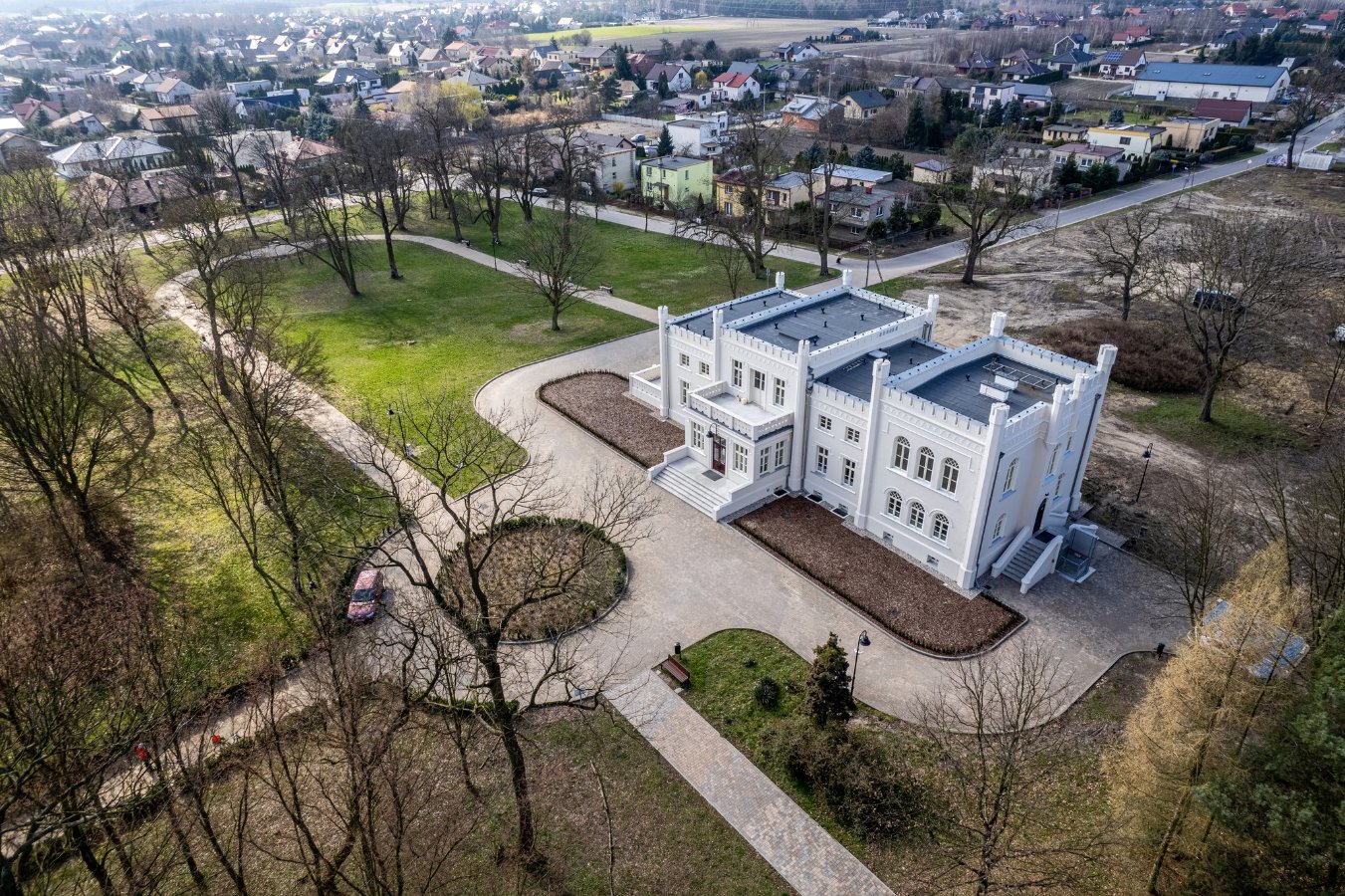
The palace in Posada, situated in the municipality of Kazimierz Biskupi near Konin, is one of the most interesting surviving country estates associated with the Wierusz-Kowalski family. Built in the second half of the 19th century, for decades it remained the family home, the centre of the estate and a place associated with the artistic activities of Karol Wierusz-Kowalski. Its picturesque structure, surrounded by a historic park, still serves as a reminder of the world of the Greater Poland landed gentry and its culture.¹
ARCHITECTURE OF THE PALACE
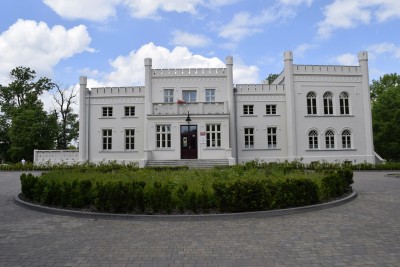
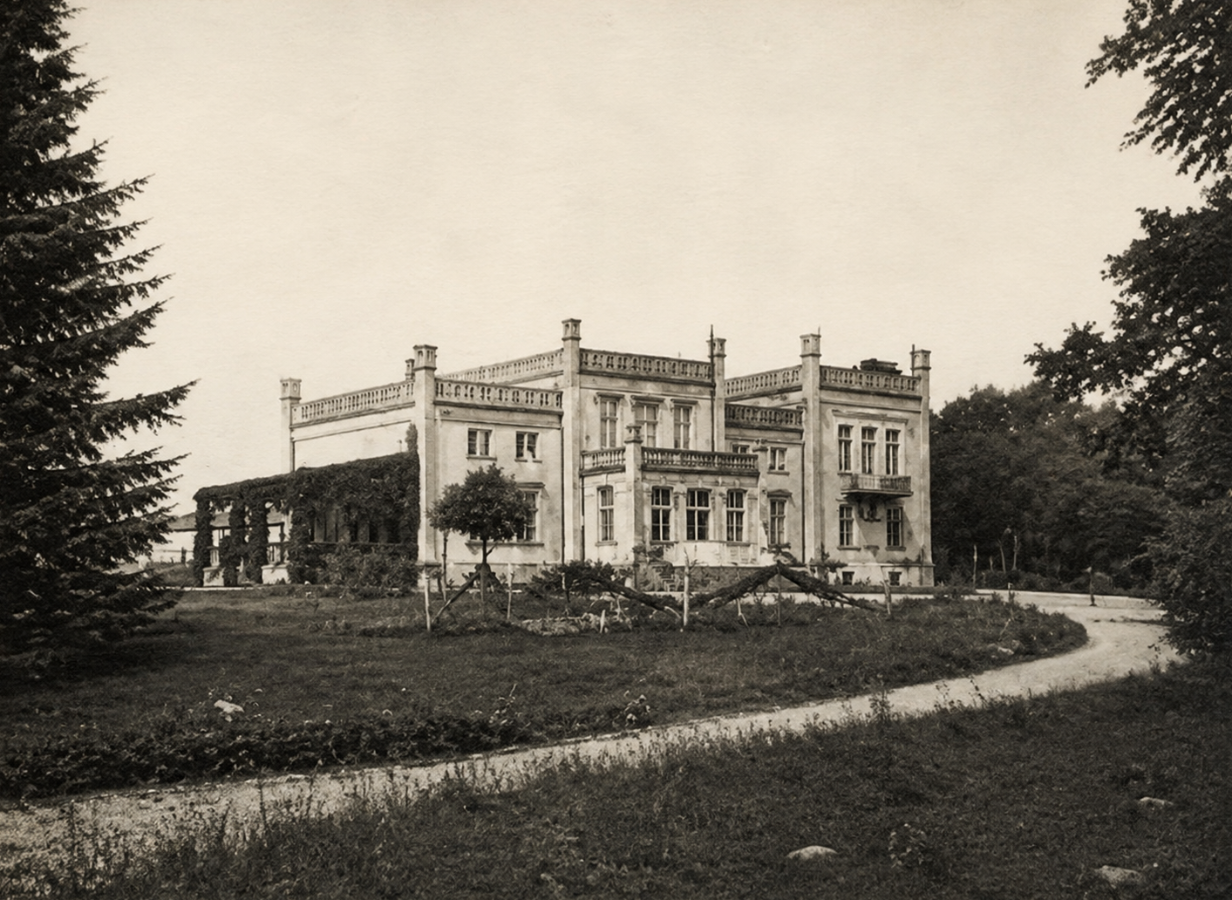
The building was designed on a rectangular plan, giving it a stately character and distinct Neo-Gothic features. The most recognisable feature is the battlementing crowning the upper part of the façade, which lends the palace an air of defensive architecture. At the front is a central risalit preceded by a porch and a flight of steps, above which a terrace has been arranged. The eastern façade, which serves as the main façade, has ten axes, and its composition is enhanced by projecting sections of the building and carefully arranged window openings.¹
The other façades also feature varied designs. The southern façade is three-axis and features a terrace in front of the entrance; the western façade has nine axes, and the northern façade three. The corners of the building are pilastered, and the pilasters extend above the roof into crenellated pinnacles, emphasising the English Gothic influences. The main entrance is preceded by a symmetrical flight of stairs with a solid, full balustrade. The entrance to the cellar is situated beneath the landing.¹
INTERIORS AND PARK
The interior layout was designed to serve both representative functions and the everyday needs of the residents. The focal point of the ground floor is a spacious hall with a drawing room situated on the central axis. Rooms arranged in a two-bay layout are situated on either side of it. On the first floor, a narrow corridor runs the length of the building between the wings. This arrangement combined practicality with the stately character of the residence.¹
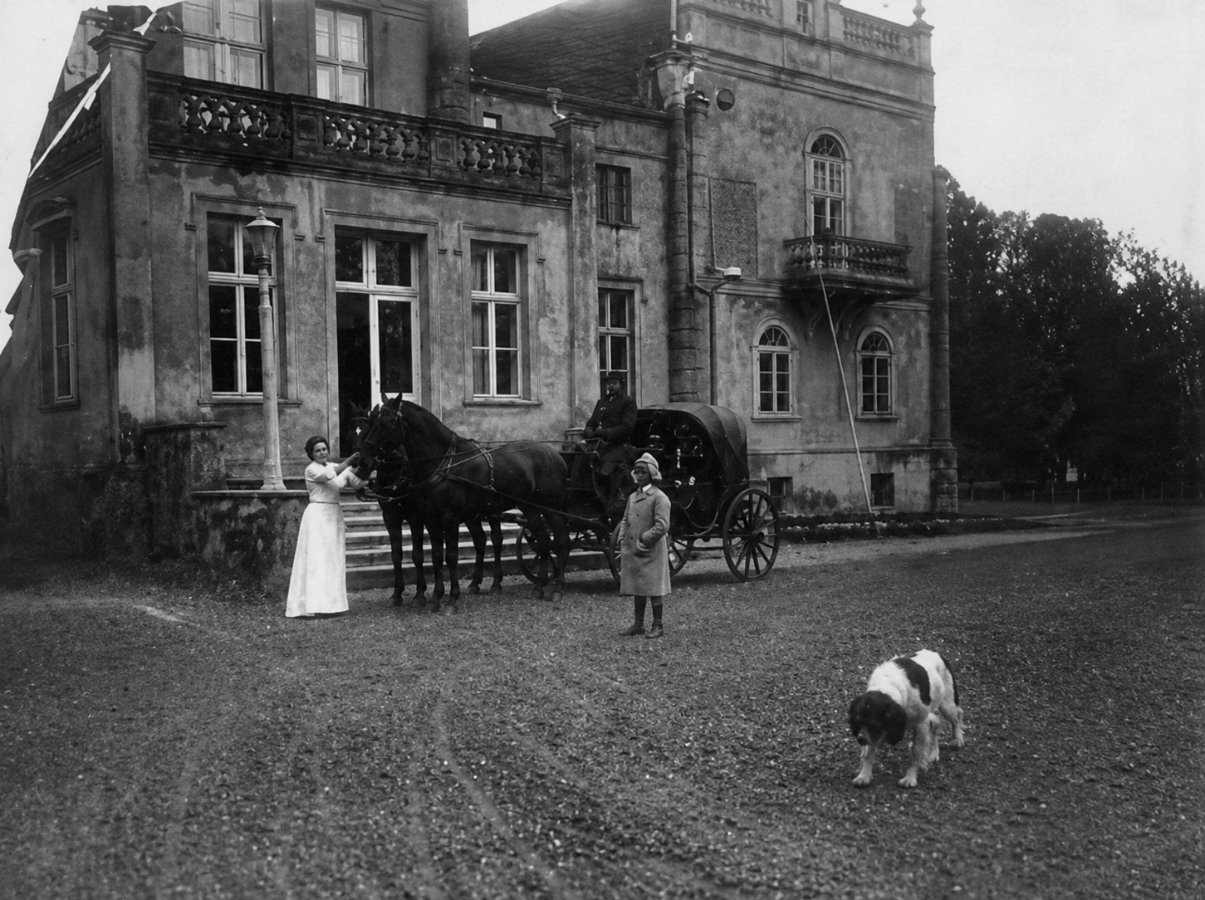
An integral part of the complex is the historic park surrounding the palace. Old trees, avenues and open spaces emphasise the picturesque nature of the building and reinforce the impression of the residence’s distinctiveness from the surrounding buildings. Preserved photographs show the palace from various angles, making it possible to examine both the proportions of the individual façades and their relationship with the greenery. Particularly distinctive were the climbing plants, which over the years covered parts of the walls and became one of the most recognisable features of Posada’s appearance prior to the most recent renovation.¹
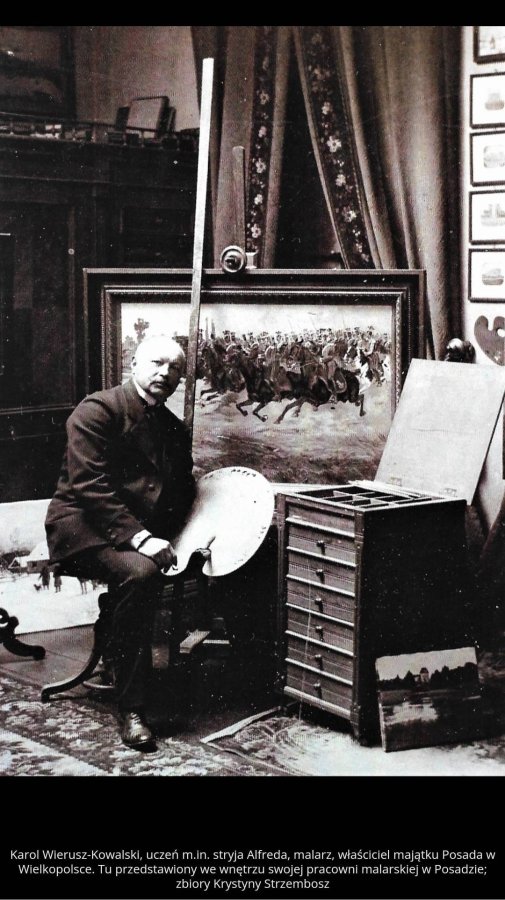
KAROL WIERUSZ-KOWALSKI AND POSADA
Karol Wierusz-Kowalski had a particularly strong connection with the palace; after returning to Poland, he took up residence at Posada in 1899. He was a painter trained in Munich, where he studied at the Academy under Gabriel Hackl; prior to that, he had honed his skills, amongst other things, through lessons with Juliusz and Wojciech Kossak.² Posada became for him at once a family home, a place of work and a source of artistic inspiration.
Karol’s connection with the palace gave the residence a distinctive character. Here, the life of a landowner was intertwined with his work as a painter, whilst the park, ponds, country lanes and the landscape surrounding the estate provided subjects for his subsequent paintings. Posada was therefore not merely an inherited residence, but a space in which the artist consciously combined his duties as a landowner with his own creative work. The palace thus became an important link in the family’s history – a place where the family’s tradition met the artist’s everyday experience.
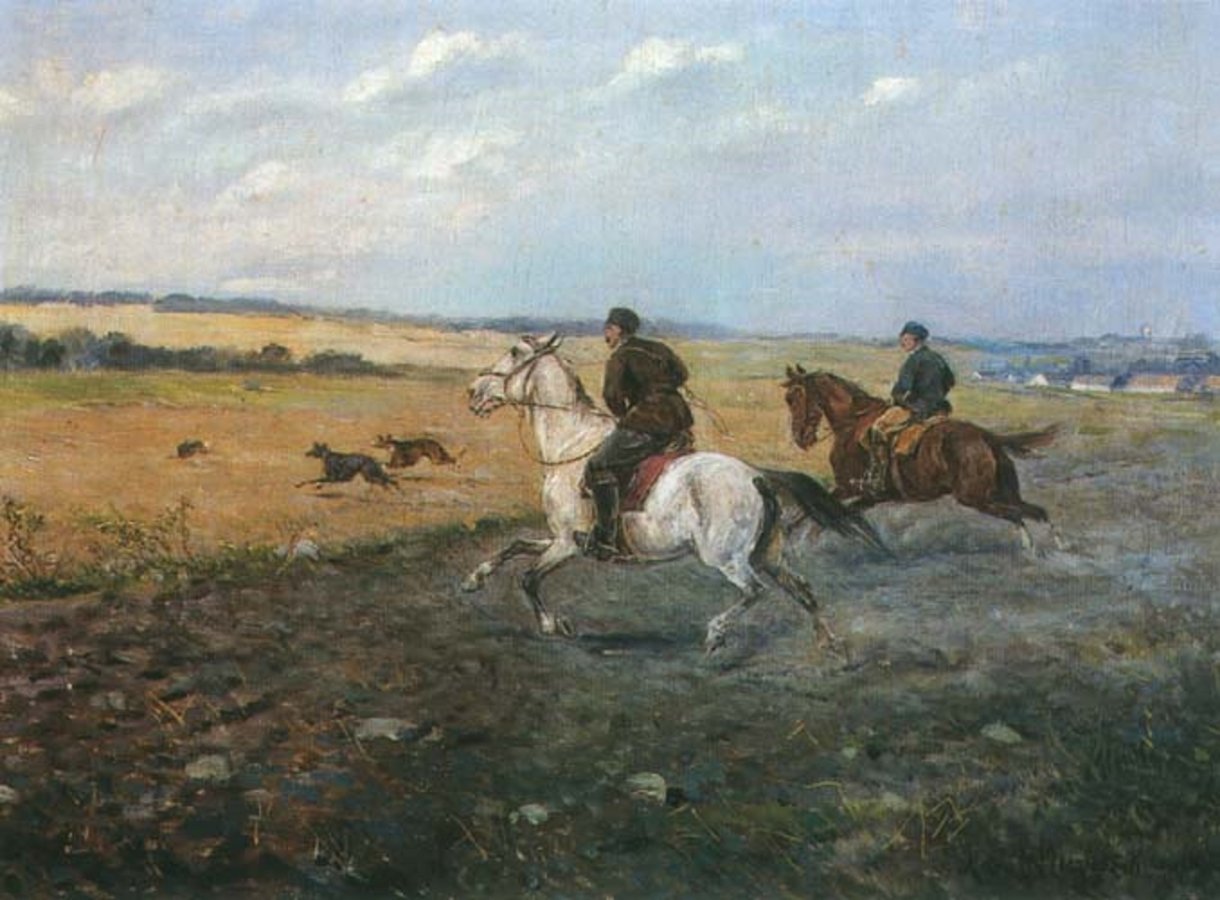
KAROL’S WORK AT POSADA
Karol Wierusz-Kowalski primarily created genre scenes and landscapes. Works mentioned in the sources include *Horsemen and a Cart Leaving a Polish Village* (1895), *Return from Holiday* (1898) and *Cottages in the Mist* (1924), all painted during his time in Posada.² His paintings were exhibited in Poznań, Łódź and Bydgoszcz, as well as at exhibitions organised by the Society for the Encouragement of Fine Arts in Warsaw.
Posada, however, remained his primary point of reference. The local landscape, architecture and rhythm of life on the estate formed the natural setting for his work. Unlike artists who devoted their entire lives to their exhibition careers, Karol combined painting with the daily duties of a landowner. The palace served as a residence, but also as a space for creative work and for storing part of the family’s collection.
A significant event in his career was the design, in 1921, of the welcome arch at the Słupca tollgate to mark Józef Piłsudski’s arrival in Konin.² This demonstrates that his artistic activity was not confined solely to easel painting. He was also able to apply his skills to public and representational projects.
FAMILY AND ARTISTIC TIES
Karola was linked to Alfred Wierusz-Kowalski by both family ties and their shared experience of the Munich art scene. Alfred owned an estate in nearby Mikorzyn, which meant that two important residences linked to the family’s history of painting were situated within a short distance of one another.¹ Posada, however, had a character all of its own, closely tied to Karol’s everyday life and his decision to remain in the country.
A significant portion of the artist’s body of work was lost during the Second World War.² This makes the surviving paintings, photographs and materials—which allow us to reconstruct his life and the appearance of the family estate—all the more valuable. The palace has weathered the changes that have erased many traces of the former landed gentry world, and remains one of the most vivid physical testimonies to the presence of the Wierusz-Kowalski family in this part of Greater Poland.
THE SIGNIFICANCE OF POSADA
The palace in Posada is significant not only for its architecture. Its importance stems primarily from the intertwining of the site’s history with that of the family. The preserved building, the park and photographs of its former appearance allow us to imagine the space in which the lives of successive generations unfolded over the decades. For Karol, it was also a creative space, without which it is difficult to fully understand his painting and his life choices.
The palace and the surrounding park were also a place where family life intertwined with local community life. Karol did not confine himself to the role of a landowner or a painter working solely for himself. His presence in Posada was linked to his participation in the life of the local area and his conviction that the position of a landowner entailed responsibilities towards the local community.¹
The proximity of Mikorzyn is also significant for the family’s history. The two country houses formed a distinctive family landscape linked to two painters and their differing life paths. Alfred built an international career primarily in Munich, whilst Karol deliberately settled in Greater Poland.
The surviving records of his paintings and activities show that this decision did not mean he had abandoned art. On the contrary, painting became an integral part of life on the estate. As a result, Karol’s body of work now also serves as a visual record of the places, people and landscapes that shaped everyday life at Posada in the first half of the 20th century.
THE PALACE’S POST-WAR HISTORY
The Second World War and the early post-war years fundamentally altered the function of Posada. After 1945, the estate passed into state ownership, and the palace ceased to serve as a family residence. In the decades that followed, it was used for residential and functional purposes, which entailed alterations to the interiors and the gradual loss of some of the original furnishings.³ Karol Wierusz-Kowalski remained associated with Posada until 1951, when he was forced to leave. He died in Poznań two years later.⁴
In the post-war period, the building underwent further changes in its function. Part of the palace housed flats; later, the building also served as accommodation for migrant workers associated with the region’s burgeoning mining industry. Following a fire, it was rebuilt and adapted for office use. Over time, following further administrative changes, it came under the ownership of the Kazimierz Biskupi local authority.⁵
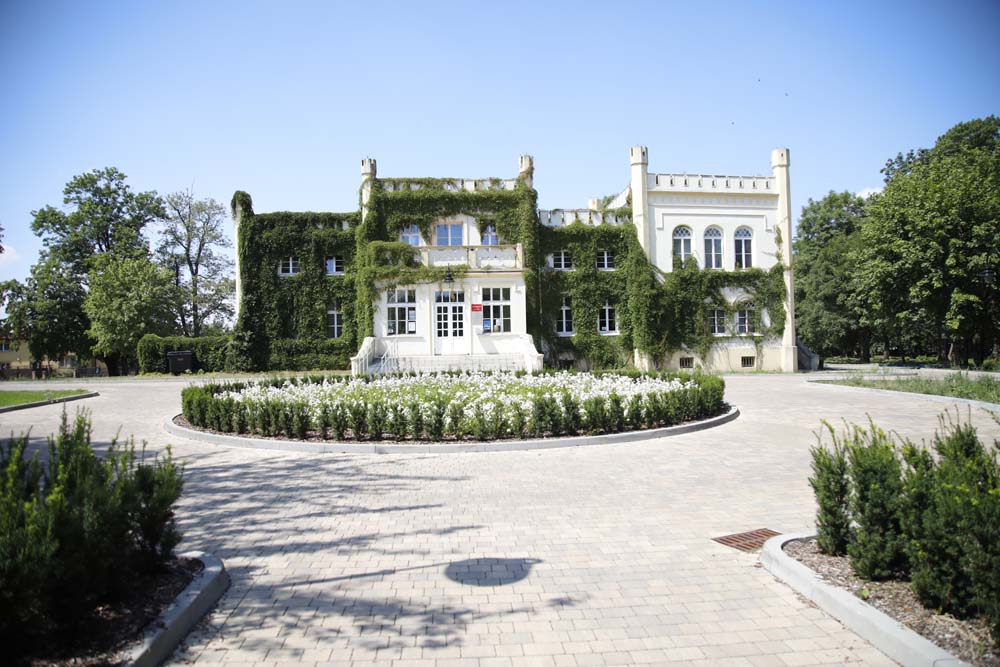
Since 2015, the palace has been a branch of the Kazimierz Biskupi Municipal Cultural Centre. It hosts classes for children and adults, as well as meetings of local groups and associations.⁶ As a result, the former manor house has once again become a venue for social and cultural activities, albeit in a completely different form to that seen in the days of the Wierusz-Kowalski family.
In 2022, extensive renovation work was carried out on the exterior of the palace. The work included, amongst other things, the restoration of the façade, terraces, window and door frames, and the staircase. The cost of the project exceeded 1.8 million zlotys, of which 1.5 million zlotys came from the Government Local Investment Fund.⁷ The renovation restored the clarity of many architectural details and emphasised the building’s neo-Gothic character.