
RECONSTRUCTION OF THE PAINTING ‘THE ATTACK OF THE WOLVES’
.
.
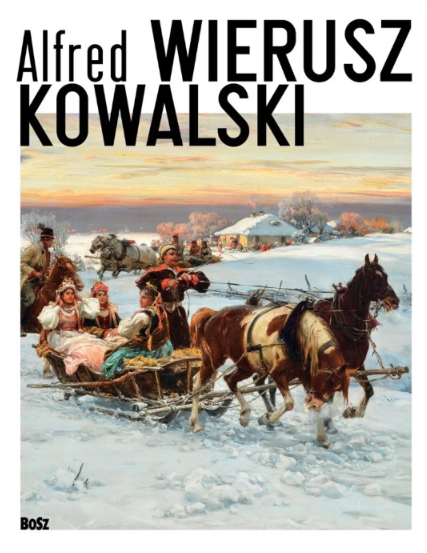
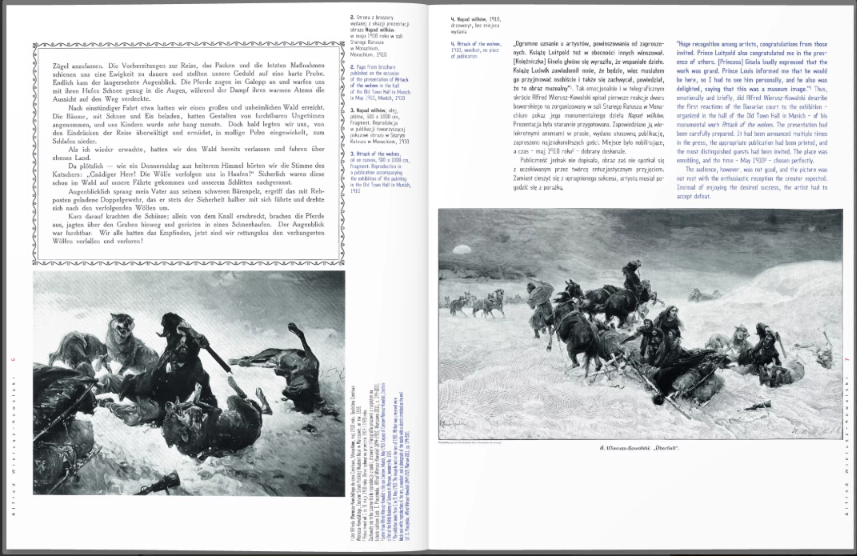
- A page from a brochure published to mark the presentation of the painting *The Wolf Attack* in May 1910 in the hall of the Old Town Hall in Munich, Munich, 1910. Source: Eliza Ptaszyńska, Alfred Wierusz-Kowalski, BOSZ Publishing, 2021.
“Enormous acclaim from the artists, thanks from the guests. Prince Luitpold, in the presence of others, offered his congratulations. [Princess] Gisela mainly remarked that it was a magnificent work. Prince Ludwig had informed me that he would be attending, so I had to receive him personally; he, too, was delighted and said it was a museum-quality painting.”
This is how Alfred Wierusz-Kowalski, in an emotional yet concise account, described the initial reactions of the Bavarian court to the exhibition of his monumental work *The Wolf Attack*, held in the hall of the Old Town Hall in Munich. The event had been meticulously organised. It had been announced repeatedly in the press, a special publication had been produced, and the most distinguished guests had been invited. The venue was prestigious, and the timing – May 1910 – was perfectly chosen.
However, the audience was sparse, and the painting did not receive the enthusiastic reception the artist had anticipated. Instead of rejoicing in his long-awaited success, the artist had to come to terms with failure.
In the Munich studio – a chapter from Eliza Ptaszyńska’s book *Alfred Wierusz-Kowalski 1849–1915*, published by DiG, Warsaw 2011
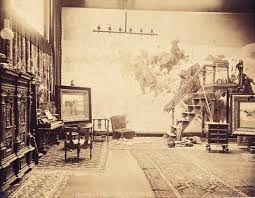
<< In the studio, lit by side light streaming in through a high-set window, a canvas bearing a painting is stretched across the entire wall. The painter is not on the tall staircase to the right of it. On the steps lies an abandoned painter’s smock; on the floor, in a jar, stand brushes; further on, there are scattered materials and items of clothing. The studio is filled with massive, bourgeois furniture, amongst which stand easels and framed paintings. Against the wall stands an open grand piano, next to it a large, richly carved wardrobe and armchairs, and a cabinet on castors. On the floor are carpets and a wild boar hide. Scattered around are a few trinkets, flowers and small items of furniture. A heavy, patterned curtain covers the wall beneath the window. Every element of the interior testifies to the wealth and stability of the household’s inhabitants.
The painting is almost complete; enormous in size, 5 by 10 metres¹, it depicts a terrifying scene of wolves attacking a sleigh. The drama unfolds in a snow-covered wasteland. The travellers crossing it have been attacked by a hungry pack of wolves. Driven mad by fear, the four horses break free from the harness; a terrified mother tries to protect her children, whilst the men defend themselves against their attackers.
The steps obscure a significant part of the painting. To the right of the sledge, in the lower corner of the canvas, the most dramatic scene unfolds. A man, half-reclining in the snow, fights off the wolves attacking him.
This section, small in relation to the whole painting, could stand alone as a separate work. In terms of composition and content, it is a self-contained piece. Here, it complements the dramatic narrative with a tragic episode. From the point of view of building tension in the painting, this is a successful artistic choice. At first glance, the viewer takes in the entire painting, and then gradually discerns the individual acts of the tragedy.
Footnote 1. The German press (e.g. *Münchner Woche für Theatre, Musik und Kunst* of 7 January 1910) reported that the painting *The Wolf Attack* measures 6 × 12 metres.
The painting is superbly composed. The action takes place in the central section of the canvas, but its dynamism means that it fills the entire surface with its energy. The diagonal along which the sleigh is positioned has been broken. Driven mad by fear, the animals have lunged to one side and are striving to escape. It is their movement that defines a new line. This intersection of diagonal directions lends dynamism to the action. One can see the thronging bodies, hooves planted in the snow or raised upwards, flared nostrils, and muzzles open in terrified neighing. Such a group would have disrupted the composition. And any gallery in which it were displayed, were it not for the vastness of the winter wasteland, which forms such an essential part of this scene. Essential, because it sets the mood, heightens the terror of the situation, and emphasises nature’s hostility towards humankind.
These snowy wastelands also play an important role in the structure of the painting. They act as a counterbalance to the scene unfolding in its central section, neutralising it compositionally, and, through their emptiness, providing the space for such a crowding of bodies and emotions. Were it not for this device, the viewer would be unable to follow and experience the drama unfolding before their eyes. They would stand, as before Matejko’s *The Battle of Grunwald*, helpless and bewildered, their eyes wandering from figure to figure, unable to take in the whole scene at a glance.
The artist deliberately distributed the formal elements. The swarm of horses dominates the scene with its mass, dark colour and violent movement. This force is balanced by the empty, snow-covered lower section of the work and the sloping hills in the upper section.
The compositional tensions of the scene are channelled in yet other directions. A woman with a group of children, filled with fear, tries to enfold them with her outstretched arms. They have all turned away from the drama unfolding behind their backs. The viewer, however, can observe on their faces the emotions they are experiencing at this moment of mortal danger. The artist achieved a similar effect of shifting the tension from the central part of the painting to its periphery by placing a pack of wolves on the ridge of the hill to the left. Those at the head of the pack are preparing to attack, whilst others are approaching slowly from behind. They are still watching, but in a moment they too will rush into the fray. In the background are snow-capped hills, with half the sun setting behind them.
Even the finest playwright could not have composed this scene any better. The viewer, struck by the horror of the life-and-death struggle unfolding before their eyes, follows its course. They notice the terrified horses, the frightened family, and the father defending them. Their eyes race across the canvas. They see the animals encircling the travellers, herds of attackers emerging from the snowy wastelands.
The facial expressions and gestures of the drama’s characters are theatrically exaggerated. In opting for such powerful expression, the artist – much like the builders of temples in ancient Greece – took into account the fact that the painting would be viewed from a certain distance. At such a distance, all subtleties would go unnoticed. The artist was keen to make a strong impression.
He did not trust in the viewers’ natural instinct for empathy, and this may well have been the reason for this exaggerated manner of expressing the characters’ emotions.
With a canvas of such immense proportions, it was impossible to study it up close, to search for details or the finer nuances of the depiction. It was intended to appeal to the average viewer—one who does not look for subtle colour variations in a painting, is not captivated by the chiaroscuro that creates the painting’s space and atmosphere, and does not look for glints on the snow, flashes of light on a speck of ice, or the fluffiness of fur. It was meant to dazzle the viewer, but not with the intricacies of a mythological scene or the message of a historical scene, which they would not be able to unravel. The painting was intended to move the viewer with a depiction that was comprehensible, yet exotic enough to hold their interest.
Such a painting was *The Wolf Attack*.
Andrzej Pieńkos established that artists furnishing their studios in the second half of the nineteenth century were guided by two principles². The first was to demonstrate the owner’s wealth and, at the same time, his ‘worldliness’. The second was the collection, within the studio, of objects that created its distinctive atmosphere. These objects ‘not only made an impression, but could also be helpful in the creative process (either directly as models or indirectly, by sending out “impulses”)’. “These two principles,” states the art historian, “were, however, governed by a third: the creation of a distinctive, personal world, a Kunstwelt, a showcase of artistry and, at the same time, a new kind of locus amoenus, in which the pleasure of being there stemmed from the artist’s self-satisfaction”³.
The studio described was certainly furnished in accordance with the first of these two principles. It is lavishly furnished, with a sufficient number of objects to attest to this. In its arrangement, however, there was less thought given to creating outward signs of ‘worldliness’ and wealth, and more attention paid to the comfort of the user, who was the artist working there. He, too, amassed piles of accessories, costumes, belts, shoes, beads and fabrics, but he did not display them. His world was not the external glitz of objects, but his creative work, plans and achievements. It was from this that he derived his ‘joy of living’ and ‘self-satisfaction’.
The studio was furnished on a grand scale. Nothing within it suggests artistic disorder, uncertainty about one’s fate or one’s work. There is nothing in it of artistic disarray or scarcity. What is missing is something that speaks solely of the artist himself. Not about his status, role or relationships, but about him personally – his character, temperament, tastes and fascinations. This is the studio of a painter who has achieved success and needs nothing more than his work.
Footnote 2. A. Pieńkos, The House of Art: Artists’ Residences in Modern European Culture, Warsaw 2005.
Footnote 3. Ibid., p. 118. >>