The painting ‘Winter – Napoleon’s Retreat from Moscow’ in the National Museum’s collection
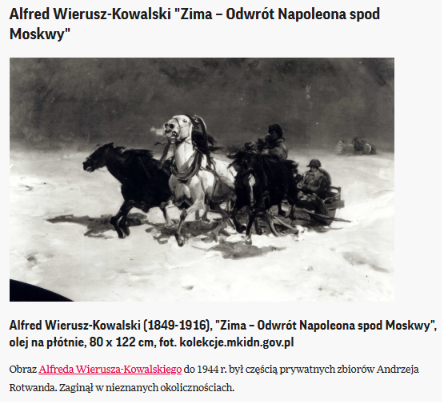
The Second World War also resulted in enormous losses to the body of work by Alfred Wierusz-Kowalski, whose paintings prior to 1939 were held in many private collections in Warsaw. According to the list contained in *Zrabowana Warszawa* (*Looted Warsaw*), the volume devoted to the private collections of the capital’s residents alone lists over 100 lost paintings and works attributed to Alfred Wierusz-Kowalski – some of these are listed by title, others only by the artist’s name. The documentation was compiled primarily on the basis of post-war loss questionnaires, reports, memoirs and pre-war exhibition catalogues; therefore, this figure may not be definitive. *Stolen_Warsaw_Volume_2_compre…* Among the lost works are, amongst others, *Wolves at Night*, *Harvest*, *Early Spring*, *The Wolf*, *Attack of the Wolves*, *Sanna – The Courtship*, *The Nightmare*, *The Horseman*, *Return from Church*, *The Kibitka* and *The Wolf in the Snow*. An example of the scale of the losses is the collection of Stanisława Kondras, which included four paintings by Wierusz-Kowalski, lost during the Warsaw Uprising.
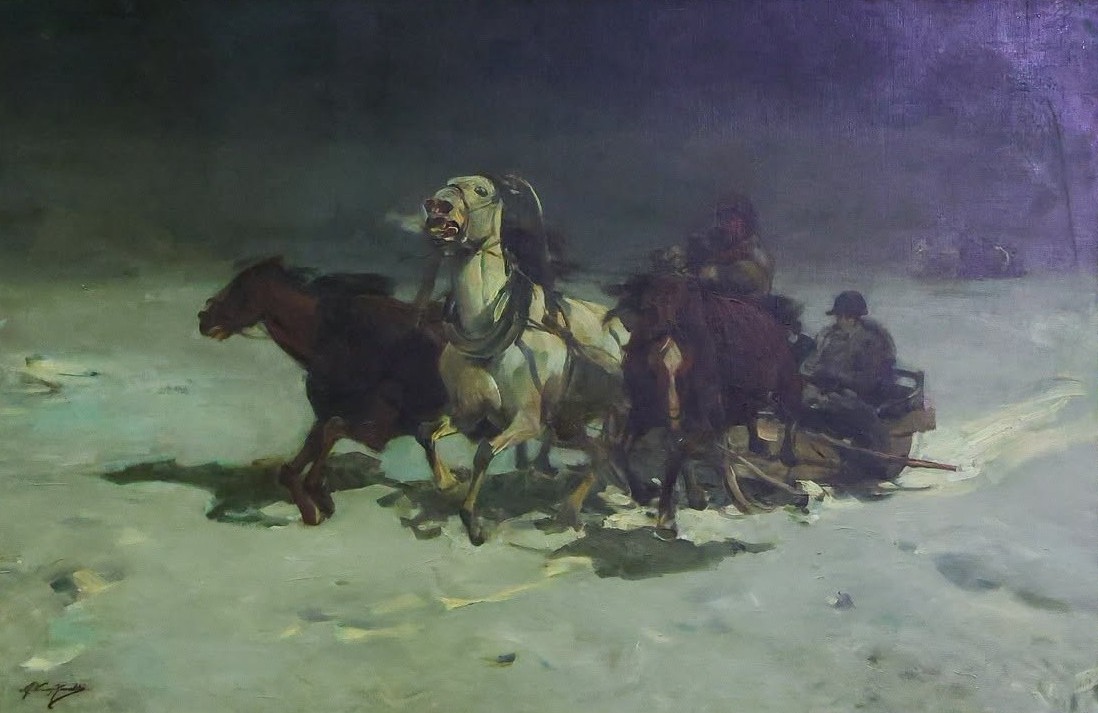
A special place amongst these works is occupied by the painting known today as ‘Winter – Napoleon’s Retreat from Moscow’, which was part of Andrzej Rotwand’s collection before the war. After the Rotwand family’s villa on Chocimska Street was seized by Gestapo officers, part of the collection remained on site, whilst most of the paintings had previously been deposited at the National Museum in Warsaw; following the Warsaw Uprising, these collections were transported to Germany, although some were successfully recovered after the war. Looted_Warsaw_Volume_2_compre… Rotwand’s list of losses includes a work by Alfred Wierusz-Kowalski entitled ‘Napoleon’s Return from Moscow’, an oil on canvas measuring 80 × 122 cm, whilst the pre-war catalogue of the Zachęta also lists a painting entitled ‘Winter’, signed by the artist and measuring exactly the same dimensions. Plundered_Warsaw_Volume_2_compre… The similarity in dimensions and provenance suggests that these may be different titles for the same work, later referred to as *Winter – Napoleon’s Retreat from Moscow*. The painting is a particularly important example of the complex history of Polish works of art: private ownership, disappearance during the war, removal from the country, and subsequent attempts at identification and recovery. This story also shows that describing a painting as ‘lost’ does not always mean it has been physically destroyed – some works may have survived the war and remained in unknown collections for decades. Therefore, documenting historical collections and publishing information about the missing works of Alfred Wierusz-Kowalski may still lead to further discoveries.
Based on: ‘Looted Warsaw: Losses in the private and art collections of Warsaw’s residents between 1939 and 1945’. Author: Mariusz Klarecki, Warsaw 2024
Link to the publication: https://www.gov.pl/web/kultura/zrabowana-warszawa-straty-w-prywatnych-zbiorach-i-artystycznych-kolekcjach-mieszkancow-warszawy-w-latach-1939–1945
Link to the report on the handover of the painting to the National Museum on 28 September 2026
https://www.youtube.com/watch?v=KCdjd8bSc_0
https://www.facebook.com/reel/1384047653886764?locale=pl_PL
A recovered painting by Alfred Wierusz-Kowalski has been handed over to the National Museum in Warsaw
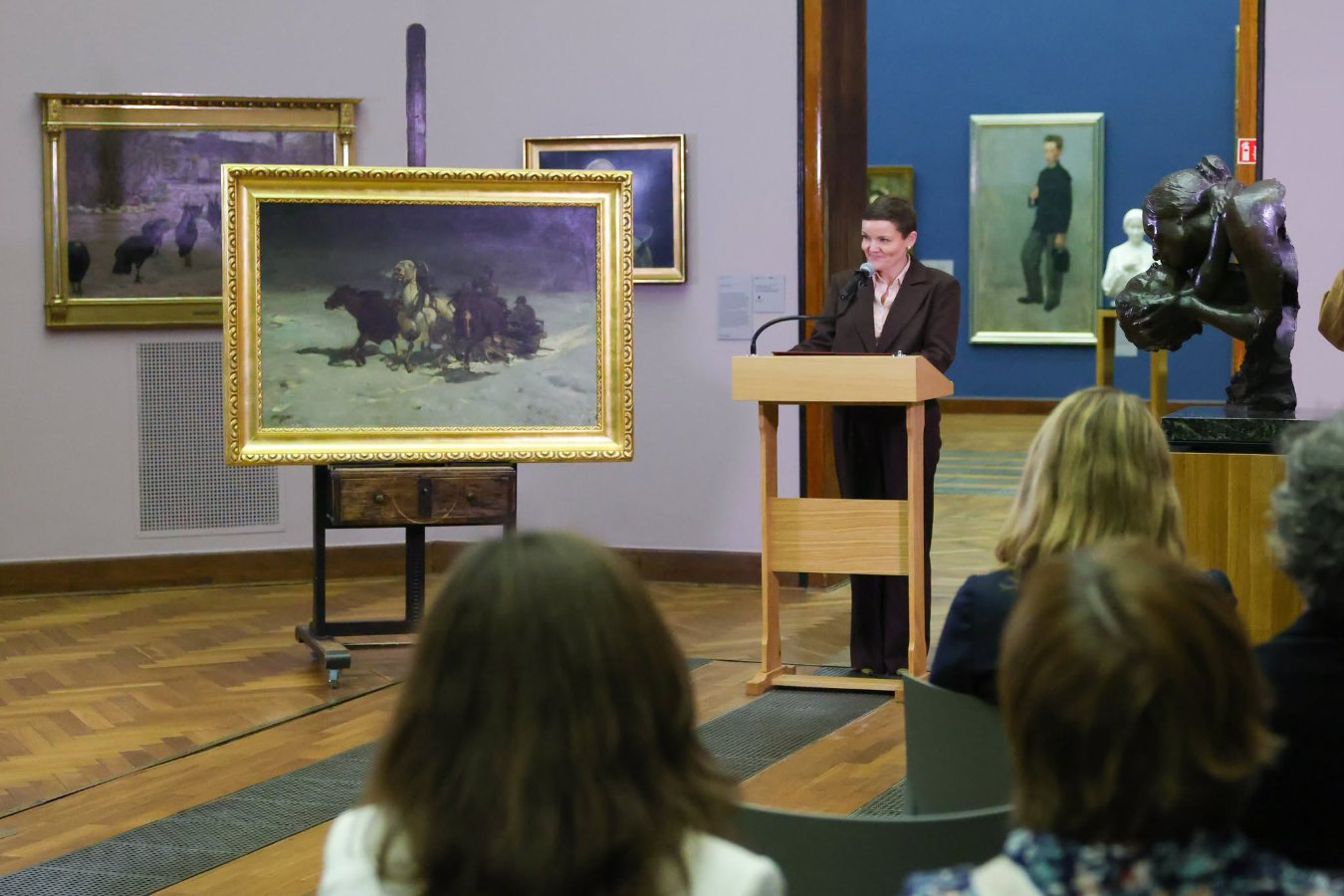
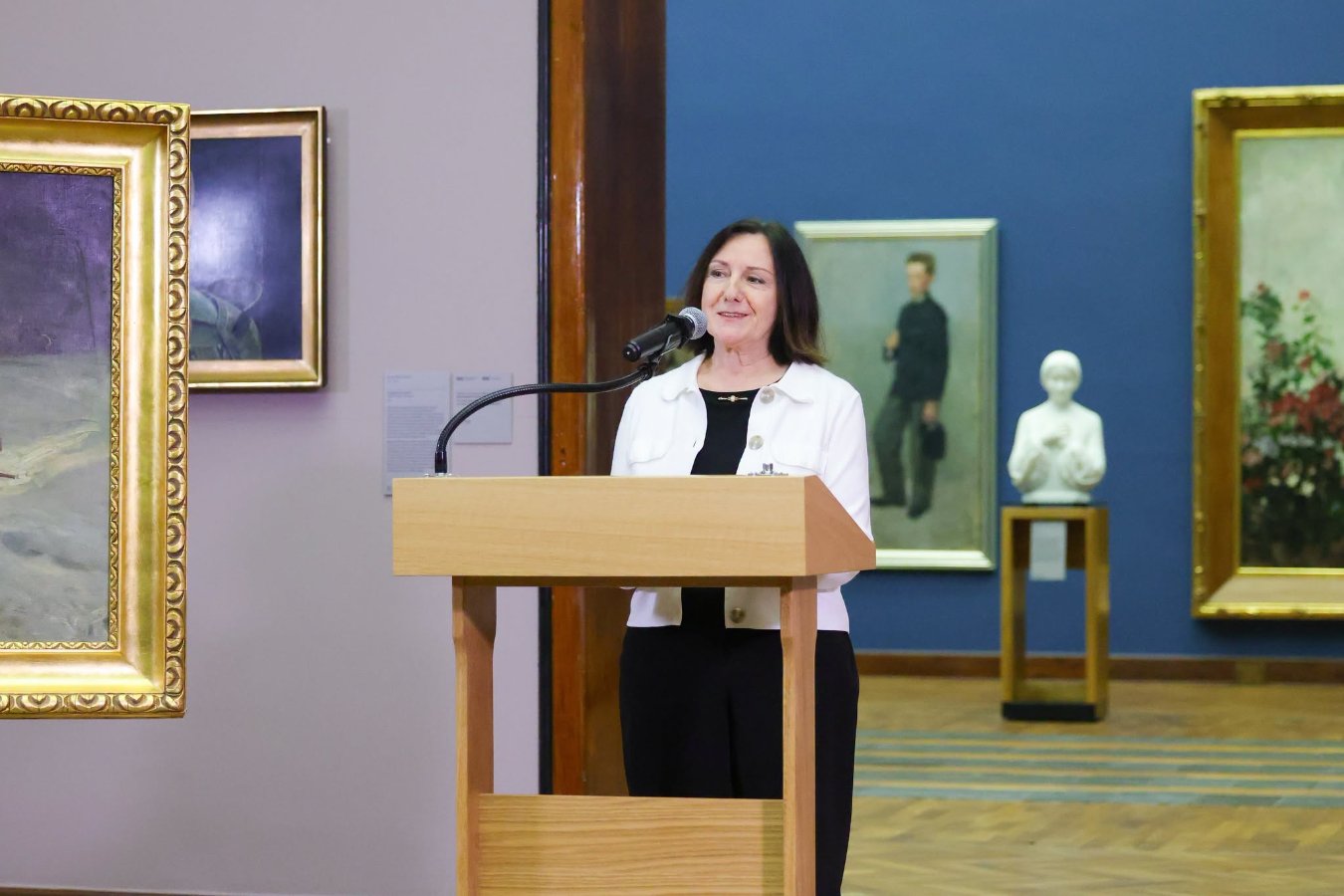
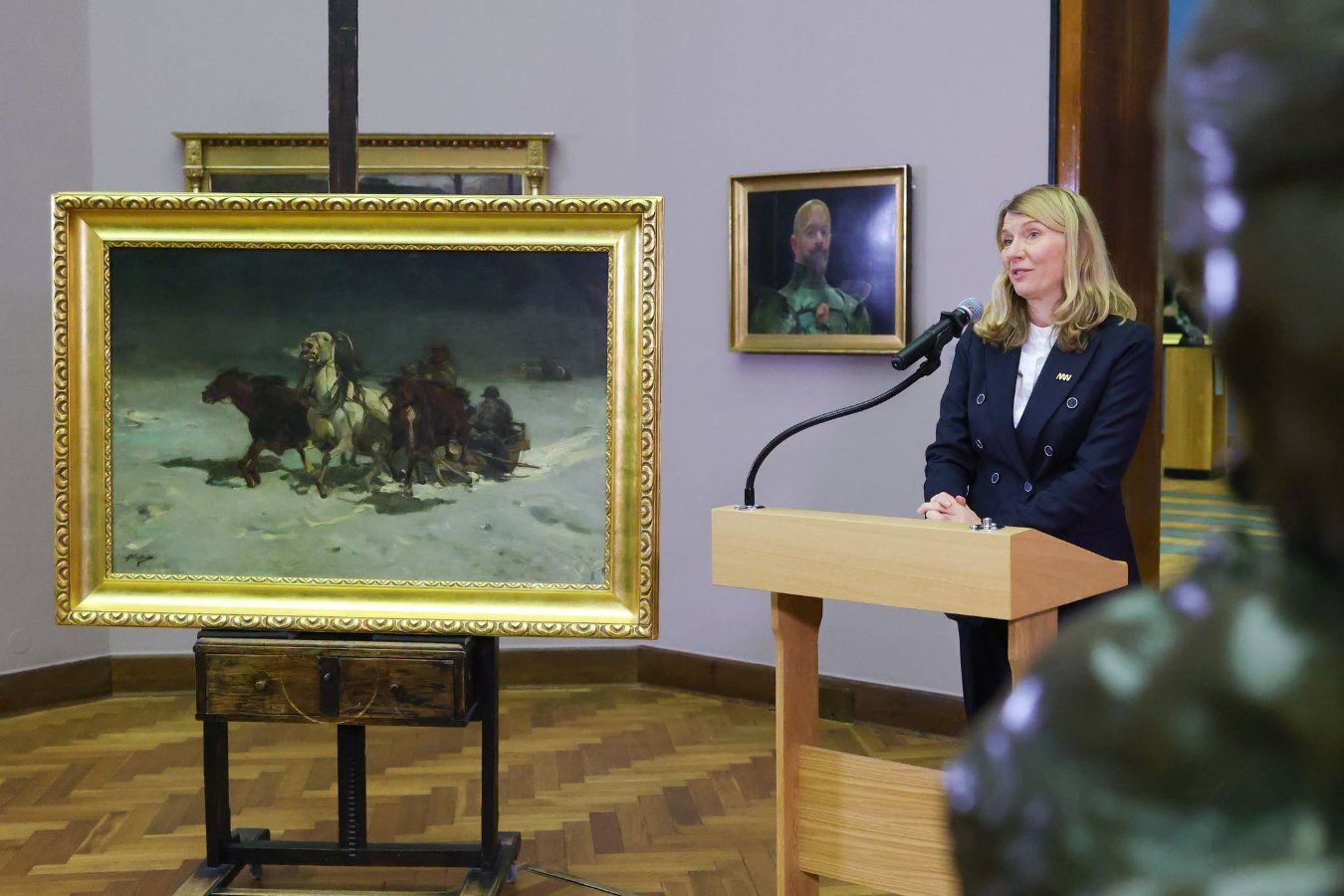
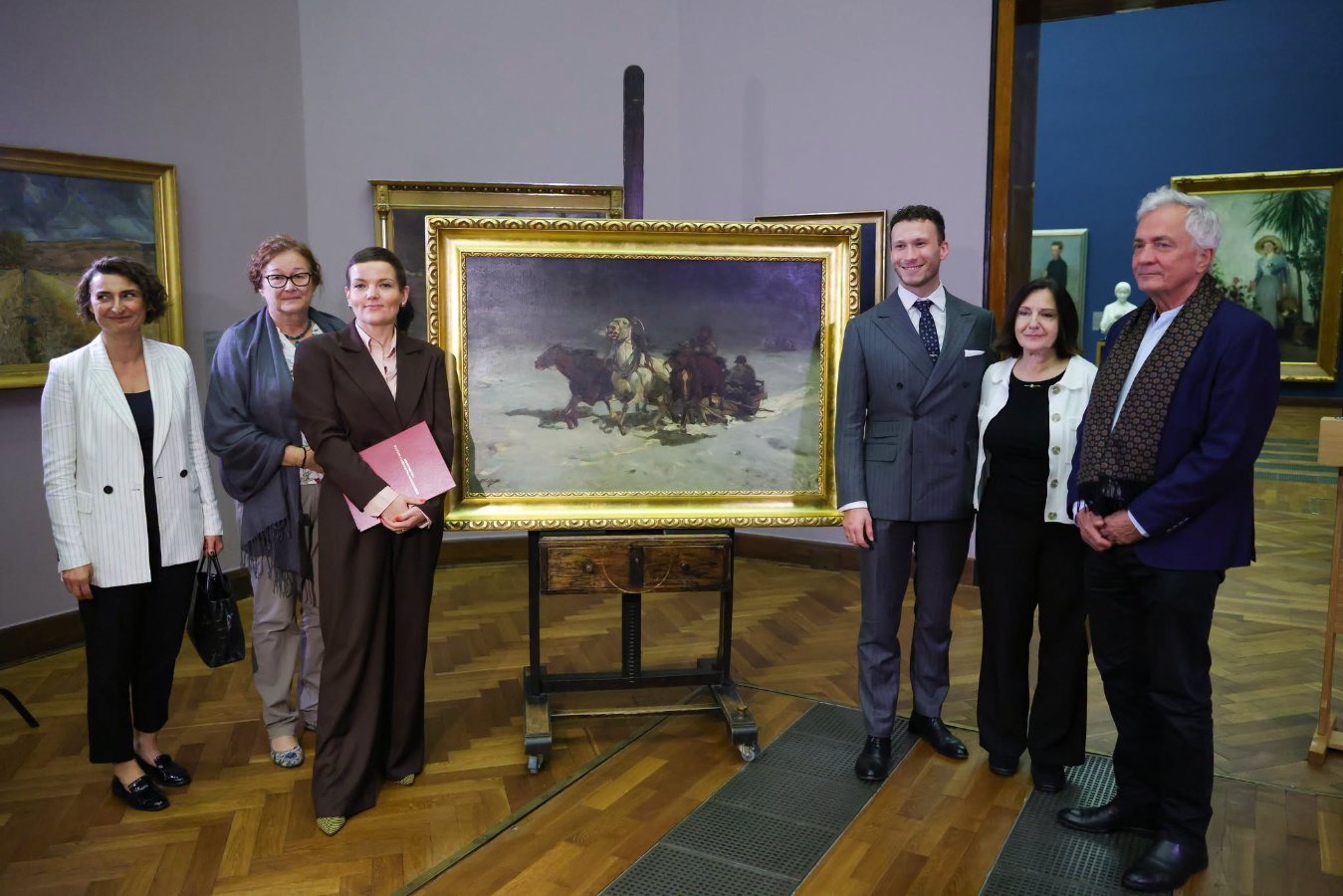
On 28 September 2026, a ceremony was held at the National Museum in Warsaw to mark the handover of a recovered Polish war loss – Alfred Wierusz-Kowalski’s painting *Winter – Napoleon’s Retreat from Moscow*. The event was attended by Marta Cienkowska, Minister of Culture and National Heritage, representatives of the National Museum in Warsaw, and those involved in the recovery of the work. The painting has been added to the collections of the National Museum in Warsaw.
The work is a particularly interesting example of Alfred Wierusz-Kowalski’s oeuvre. The artist is known primarily for his genre scenes, depictions of journeys, horse-drawn carriages, wolves and winter landscapes. In this instance, however, he turned to a historical subject – the dramatic retreat of Napoleon’s army from Moscow in 1812. Agnieszka Lajus, Director of the National Museum in Warsaw, pointed out that it is precisely this historical theme that makes the painting unique within the artist’s oeuvre.
History of the painting
Before the Second World War, the painting belonged to the collection of Andrzej Rotwand, an engineer and banker, whose family had built up one of the most important private collections of Polish painting. It also included works by, amongst others, Jan Matejko, Wojciech Gerson and Józef Brandt.
From June to September 1939, *Winter – Napoleon’s Retreat from Moscow* was on display at the Zachęta in Warsaw as part of the exhibition *The First Forty Years of the Society for the Encouragement of Fine Arts 1861–1900*. Thirty-one paintings and drawings were loaned from the Rotwand collection for this exhibition. The outbreak of the Second World War meant that the subsequent fate of many works in private collections became unknown. This also applied to the painting by Alfred Wierusz-Kowalski, which was deemed a Polish war loss.
The fate of this painting is, at the same time, part of a much broader history of Polish cultural heritage. During the Second World War, a vast number of works of art went missing from Polish museums, galleries, churches and private collections. To this day, many of them remain outside the country or their whereabouts are unknown. Every time such an object is found and correctly identified, it helps to piece together a fragment of the history of Polish collections and return the work to public view.
After many years, the painting has returned
The story of how the work was found is also remarkable. The painting was purchased in the 1960s, probably in Kraków, by Michał Stefan Koryzna. For the following decades, it remained in the hands of his family. His daughter, Ewa Tsonis, took steps to uncover the painting’s history.
Collaboration with the Ministry of Culture and National Heritage and experts from the National Museum in Warsaw made it possible to confirm the identity of the work. It is particularly valuable that the painting has been preserved in very good condition and in its original frame. Thanks to the research carried out, it was possible to link the preserved object to a work known from pre-war documentation and the history of the Rotwand collection.
The conduct of Ewa Tsonis and her family was particularly highlighted during the ceremony. Minister Marta Cienkowska thanked them for their sense of responsibility towards Poland’s cultural heritage, and Ewa Tsonis was presented with a certificate from the Minister of Culture and National Heritage. This story illustrates just how important cooperation between owners, art historians, museum professionals and state institutions can be in the process of recovering lost works of art.
Alfred Wierusz-Kowalski – a Polish and European artist
The recovery of the painting also provides a further opportunity to highlight the significance of Alfred Wierusz-Kowalski in the history of Polish painting. Born in 1849 in Suwałki, the artist spent a significant part of his career in Munich, which in the second half of the 19th century was one of Europe’s most important artistic centres. His paintings gained recognition from an international audience and found their way into collections in many countries.
Wierusz-Kowalski developed his own, easily recognisable painterly style. Vast landscapes, winter scenes, horses and horse-drawn carriages, and depictions of everyday life held a special place in his oeuvre. Winter – Napoleon’s Retreat from Moscow combines the artist’s characteristic interest in winter landscapes and movement with historical themes, which he tackled less frequently. For this reason, the work constitutes an interesting and important element of his oeuvre.
The work’s return to public collections
The transfer of the painting to the National Museum in Warsaw means that, after decades of uncertainty regarding its fate, the work has once again found its place in Polish public collections. It will be available for further study by art historians, conservators and museum professionals, and, above all, will become part of a heritage accessible to future generations.
The recovery of any lost work of art has significance that goes beyond the object’s artistic value alone. It enables us to reconstruct the history of former collections, their owners and the dramatic fate of Polish culture in the 20th century. In the case of Alfred Wierusz-Kowalski’s painting, we also have the opportunity to expand our knowledge of the work of one of the most outstanding representatives of the Polish artistic colony in Munich.
An important day for the memory of Alfred Wierusz-Kowalski
For the Alfred Wierusz-Kowalski Foundation, the recovery of *Winter – Napoleon’s Retreat from Moscow* is an event of particular significance. One of the Foundation’s primary aims is to preserve the memory of the artist, promote his work, conduct and support research, and gather information concerning his life, works and family.
The story of the recovered painting perfectly illustrates that our understanding of Alfred Wierusz-Kowalski’s body of work is by no means a closed chapter. His works remain scattered across museums and private collections in Poland and abroad, and further research may lead to new discoveries regarding their history and provenance.
The return of the painting after several decades is therefore not merely an important museum event. It is also a symbolic restoration of a fragment of Polish cultural heritage and another work by Alfred Wierusz-Kowalski to a place where it can be studied, protected and presented to the public.
The Alfred Wierusz-Kowalski Foundation notes this event with great satisfaction as another important chapter in the history of research into the life and work of our Patron.