
Czesław and Helena Amelia, née Wańkowicz, and Anna (Hanna), née Serafiński
CZESŁAW TEOFIL WIERUSZ-KOWALSKI (1882–1984)
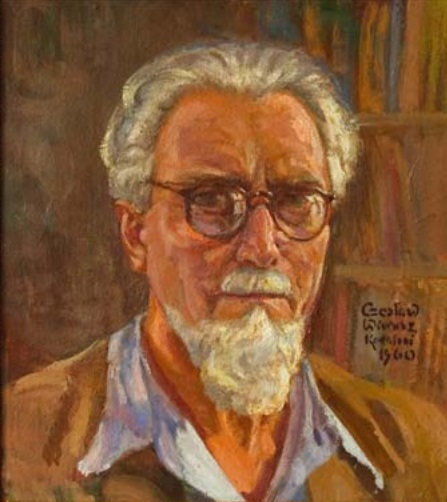
Painter, teacher, organiser of artistic life and continuator of the family tradition
Czesław Teofil Wierusz-Kowalski belonged to the second generation of an artistic family founded by Alfred Wierusz-Kowalski. He was a painter, teacher and organiser of cultural life, having rendered outstanding service to interwar Vilnius. Although he grew up in the shadow of his father’s fame, he forged his own artistic path, distinct from Alfred’s realistic style of painting. His life, spanning over a century, encompassed the period of the Partitions, two world wars, the regaining of independence and the post-war transformations of Polish culture.¹
CHILDHOOD IN MUNICH
Czesław was born on 12 May 1882 in Munich, the son of Alfred Wierusz-Kowalski and Jadwiga Bogusława, née Szymanowska. He grew up in a home where art was a natural part of everyday life. His father’s studio was a meeting place for artists, collectors and members of the Polish painting community centred around Józef Brandt.¹
He spent his childhood between Munich and Poland. After Alfred purchased the Mikorzyn estate in 1896, the family spent more and more time in Greater Poland. There, Czesław became familiar with the landscape of the Polish countryside, observing horses, lakes and the lives of the local people. His parents took care to ensure that their children, who were being brought up abroad, retained their knowledge of the Polish language and their connection with their homeland.¹
ARTISTIC STUDIES
Czesław attended secondary school in Kalisz, and then, in 1901, began studying at the Drawing Class in Warsaw under the tutelage of Wojciech Gerson. In 1904, he began studying architecture at the Technical University of Munich, whilst also studying painting at Simon Hollósy’s private school. On 27 October 1906, he was admitted to Peter Halm’s drawing class at the Munich Academy of Fine Arts.²
In 1907, he travelled to Paris, where he studied at the Académie Julian and the Académie Vitti. There, he encountered new artistic movements, including Impressionism, Fauvism and Pre-Cubism. In Paris, he maintained contact with Olga Boznańska, who painted his portrait in 1907. The work serves as a valuable testament to Czesław’s presence within the Polish artistic community in the French capital.³
Between 1909 and 1914, he worked in his father’s studio in Munich. Gradually, however, he moved away from his father’s style of painting, seeking his own means of expression. Instead of dramatic narrative scenes and horse-drawn carriages, he chose primarily landscapes, portraits, still lifes and intimate compositions.¹
VILNIUS – ARTISTIC AND SOCIAL ACTIVITIES
In 1916, Czesław settled in Vilnius, which for nearly thirty years became the most important centre of his activities. In 1920, he served in the military during the Polish–Bolshevik War. After the end of hostilities, he became involved in organising artistic life and the reconstruction of Polish cultural institutions.²
From 1921, he headed the Department of Culture and Monument Preservation within the educational structures of Central Lithuania. He was a co-founder of the Vilnius Society of Visual Artists, chaired the Inter-Union Cultural and Artistic Commission, and co-founded the monthly magazine *Południe*.²
His educational work was of particular significance. He organised art education, supported the development of the crafts, and helped young artists to gain an education. In 1937, he was one of the co-founders of the Institute of Crafts, operating under the auspices of the Vilnius Chamber of Crafts.²
At the same time, he remained an active painter. From 1911, he exhibited his works in Munich, Minsk, Warsaw, Vilnius and Poznań. In 1932, the Society for the Encouragement of Fine Arts in Warsaw organised a solo exhibition of his work.²
PAINTING
Czesław Wierusz-Kowalski consciously moved away from his father’s realistic artistic style. In his paintings, colour, light, the simplification of form and the decorative rhythm of the composition played a greater role.
An example of his mature work is the painting *Landscape Composition (Emerald Lake)* from 1933, which is held in the collection of the National Museum in Warsaw. The work demonstrates the artist’s interest in modern painterly approaches and the synthetic representation of landscape.⁴
FAMILY LIFE
Czesław’s first wife was Helena Amelia, née Wańkowicz. From this marriage came their daughter Jadwiga, known in the family as Wisienka, born on 8 February 1918 in Warsaw.⁵
Following Helena’s death, Czesław married a second time, to Anna (known as Hanna) Serafińska. They had two daughters: Joanna Wierusz-Kowalska-Turowska, born on 4 July 1930 in Vilnius, and Krystyna Wierusz-Kowalska, who lived from 1932 to 2001.¹
The Serafiński family had links to Koryznówka in Nowy Wiśnicz and to the circle of Jan Matejko’s family. The artistic traditions of both families were carried on by Joanna, who became a painter and art conservator.
POST-WAR YEARS
The Second World War brought Czesław’s time in Vilnius to an end. In 1945, he settled in Gdańsk, where he became involved in the reconstruction of cultural life. He took part in activities related to the organisation of the Franciszek Treder Kashubian Museum in Kartuzy, supported Kashubian culture, and between 1948 and 1956 gave lectures on methods of teaching drawing in schools in the Tri-City.²
In 1957, he moved to Warsaw. He continued to paint, maintained contacts with the artistic community and remained involved in cultural affairs. Towards the end of his life, he established two scholarships for young artists – one for a woman and one for a man – thereby supporting the next generation of artists.¹
Czesław Wierusz-Kowalski died in 1984 in Warsaw, having lived to the age of 102. He was buried at Powązki Cemetery in the Szymanowski family grave, the monument for which was designed by the sculptor Wacław Szymanowski.⁵
He left behind not only his paintings, but also a legacy in teaching and organisation. His work in Vilnius, Gdańsk and Warsaw forms an important part of the history of 20th-century Polish artistic life. The family’s artistic tradition was continued by his daughter Joanna, who, after moving to Paris, developed her own painterly language.
FOOTNOTES
- 1. Eliza Ptaszyńska, ‘Three Generations of the Wierusz-Kowalski Family: Styles, Eras, Countries’, *Muzealnictwo*, no. 48, Warsaw 2007, pp. 95–109.
- 2. Axel Feuß, Wierusz-Kowalski, Czesław, *Porta Polonica*, an artist’s biography covering his education, activities in Vilnius, military service and work after 1945.
- 3. Suwałki Regional Museum, materials concerning the portrait of Czesław Wierusz-Kowalski painted by Olga Boznańska in Paris in 1907.
- 4. National Museum in Warsaw, Landscape Composition (Emerald Lake), 1933, oil on canvas, 55 × 44.5 cm, inv. no. MPW 3029.
- 5. Birth certificate of Jadwiga Wierusz-Kowalska, Warsaw, Parish of the Saviour, 5 March 1918; documentation relating to the Szymanowski family grave at Powązki Cemetery in Warsaw.
Czesław W-K
HELENA AMELIA, née WAŃKOWICZ, WIERUSZ-KOWALSKA
First wife of Czesław Wierusz-Kowalski, mother of Jadwiga
Helena Amelia née Wańkowicz Wierusz-Kowalska was the first wife of Czesław Teofil Wierusz-Kowalski, a painter and organiser of artistic life, and the son of Alfred Wierusz-Kowalski. Her story is linked to the period of the First World War and the beginning of her husband’s career in Vilnius.¹
MARRIAGE AND FAMILY
Helena Amelia came from the Wańkowicz family. Her marriage to Czesław linked her to the Wierusz-Kowalski family, known primarily for the artistic activities of Alfred and his son.
Czesław Wierusz-Kowalski was already an established painter at that time, having studied in Munich and Paris. In 1916, he settled in Vilnius, where he began a new phase of his professional and social life.¹
THE BIRTH OF HER DAUGHTER JADWIGA
The most important surviving document relating to Helena’s family life is the birth certificate of her daughter Jadwiga Wierusz-Kowalska, known in the family as Wisienka.
Jadwiga was born on 8 February 1918 in Warsaw, at the house at 3 Litewska Street. The birth certificate was drawn up on 5 March 1918 at the Parish of the Saviour. The document lists Czesław Teofil Wierusz-Kowalski and Helena Amelia, née Wańkowicz, as the parents.²
The surviving certificate is a particularly valuable genealogical record. It allows us to unequivocally establish the parents’ names, the date and place of the child’s birth, and Helena’s connection to the Wierusz-Kowalski family.
IN MEMORY OF HELENA
Helena Amelia died before Czesław entered into his second marriage to Anna, née Serafińska. The available sources do not allow us to determine the date and place of her death with certainty.
Her biography remains fragmentary, as the surviving accounts focus primarily on her husband’s artistic career. Nevertheless, the birth certificate of their daughter Jadwiga enables Helena to be restored to her rightful place in the family’s history.
She belonged to a generation whose lives coincided with the extremely difficult period of the First World War and political upheavals in Europe. She remains an important link in the genealogy of the Wierusz-Kowalski family and the mother of Jadwiga, who belongs to the next generation of Alfred Wierusz-Kowalski’s descendants.
FOOTNOTES
- 1. Eliza Ptaszyńska, ‘Three Generations of the Wierusz-Kowalski Family: Styles, Eras, Countries’, Muzealnictwo, no. 48, Warsaw 2007, pp. 95–109; information concerning the family life of Czesław Wierusz-Kowalski.
- 2. Birth certificate of Jadwiga Wierusz-Kowalska, Warsaw, Parish of the Saviour, drawn up on 5 March 1918; born on 8 February 1918 on Litewska Street.
ANNA (HANNA) Z SERAFIŃSKA WIERUSZ-KOWALSKA
The second wife of Czesław Wierusz-Kowalski, mother of Joanna and Krystyna
Anna, known as Hanna, née Serafińska Wierusz-Kowalska, was the second wife of Czesław Teofil Wierusz-Kowalski, a painter, teacher and organiser of artistic life. She came from the Serafiński family, which had links to Koryznówka in Nowy Wiśnicz and the circle of Jan Matejko’s family. Her life was primarily associated with Vilnius, and subsequently with the post-war fortunes of the Wierusz-Kowalski family.¹
THE SERAFIŃSKI FAMILY
The Serafiński family holds a special place in the history of Polish culture thanks to its connections with Jan Matejko. Koryznówka in Nowy Wiśnicz, the former residence of the Serafińskis, remains one of the places that preserves the memory of the great historical painter.²
Anna was therefore brought up amidst family traditions linked to Polish art and culture. Her subsequent marriage to Czesław Wierusz-Kowalski brought together two family circles in which painting played a significant role.
MARRIAGE TO CZESŁAW WIERUSZ-KOWALSKI
Following the death of his first wife, Helena Amelia née Wańkowicz, Czesław Wierusz-Kowalski married Anna Serafińska.¹
Their family life was centred on Vilnius, where Czesław was intensely involved in painting, teaching and organisational work. He worked to promote the development of art education, the preservation of historic monuments and cultural institutions. He was a co-founder of the Vilnius Society of Visual Artists and was one of the most active organisers of the city’s artistic life.³
The Wierusz-Kowalski household was part of Vilnius’s Polish cultural milieu. Art was ever-present there, both through Czesław’s professional activities and the family traditions of the Wierusz-Kowalskis and the Serafińskis.
DAUGHTERS JOANNA AND KRYSTYNA
Anna and Czesław had two daughters: Joanna Wierusz-Kowalska, born on 4 July 1930 in Vilnius, and Krystyna Wierusz-Kowalska, who lived from 1932 to 2001.¹
From a very young age, Joanna grew up in an artistic environment. Her grandfather was Alfred Wierusz-Kowalski, her father was the painter Czesław, and through her mother’s family she was also connected to the Serafiński tradition and the legacy of Jan Matejko.
In later years, Joanna chose her own creative path. She studied art conservation at the Academy of Fine Arts in Warsaw, and subsequently devoted herself to painting. In 1962, she moved to Paris, where she developed her work in the field of lyrical abstraction.⁴
THE WAR AND THE FAMILY’S POST-WAR FATE
The Second World War disrupted the family’s life in Vilnius. Border changes and the political situation after 1945 prevented the Wierusz-Kowalski family from returning to their former home.
The family settled in Gdańsk, where Czesław became involved in efforts to rebuild cultural life and artistic education. He also became involved in initiatives relating to Kashubian culture and the organisation of museums on the coast.³
For Joanna, the post-war years were a time of education and of seeking her own career path. Initially, she was interested in music, but ultimately chose the visual arts, continuing the family’s artistic tradition.⁴
A PLACE IN THE FAMILY’S HISTORY
Anna Wierusz-Kowalska, née Serafińska, occupies an important place in the genealogy of the artistic branch of the family. Through her lineage, she linked the Wierusz-Kowalska family to the Serafiński family, who were connected to Jan Matejko and Koryznówka in Nowy Wiśnicz.
Her daughter Joanna became a representative of the third generation of Wierusz-Kowalski painters. However, she did not limit herself to continuing the style of her grandfather and father, but forged her own artistic path, which led her to Paris.
The surviving information about Anna allows us to recall her role in the history of a family whose successive generations played an active part in the artistic life of Poland and Europe.
FOOTNOTES
- 1. Eliza Ptaszyńska, ‘Three Generations of the Wierusz-Kowalski Family: Styles, Eras, Countries’, *Muzealnictwo*, no. 48, Warsaw 2007, pp. 95–109.
- 2. The Jan Matejko Memorial Museum ‘Koryznówka’ in Nowy Wiśnicz, materials concerning the history of the Serafiński family and Jan Matejko’s family connections.
- 3. Axel Feuß, Wierusz-Kowalski, Czesław, *Porta Polonica*, an artist’s biography covering his activities in Vilnius, Gdańsk and Warsaw.
- 4. Eliza Ptaszyńska, ‘Three Generations of the Wierusz-Kowalski Family: Styles, Eras, Countries’, Muzealnictwo, no. 48, Warsaw 2007, pp. 95–109; information concerning Joanna Wierusz-Kowalska-Turowska and her artistic work.