
Jerzy and Jerzyk
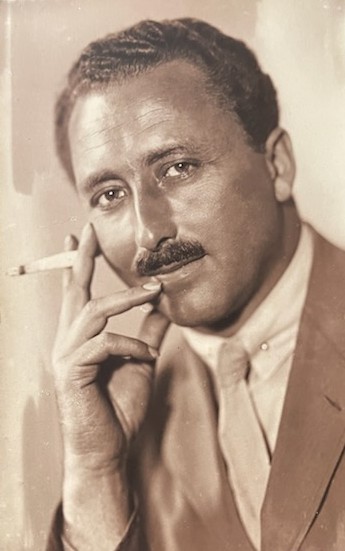
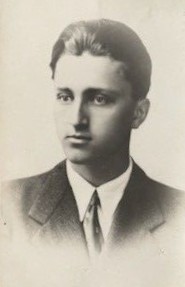
JERZY WIERUSZ-KOWALSKI (1892–1942) AND JERZY WIERUSZ-KOWALSKI (1920–DATE OF DEATH UNKNOWN)
Father and son – from the family home of Alfred Wierusz-Kowalski to their tragic fate at Auschwitz
The story of Jerzy Wierusz-Kowalski and his son Jerzy, known as Jerzyk to his family, is one of the most dramatic wartime stories of the Wierusz-Kowalski family. The father, the youngest son of the famous painter Alfred Wierusz-Kowalski, grew up surrounded by art, in a well-to-do family whose life unfolded between Munich and Poland. His son, however, belonged to a generation raised in an independent Republic of Poland. Their lives, initially centred on the family estates and plans for the future, were brutally cut short by the Second World War. Both were sent to the German concentration camp KL Auschwitz, where they were given prisoner numbers 31356 and 31357.¹
THE SON OF ALFRED WIERUSZ-KOWALSKI
Jerzy Wierusz-Kowalski was born on 10 April 1892 in Munich as the youngest son of Alfred Wierusz-Kowalski and Jadwiga Bogusława, née Szymanowska. He grew up in an artistic milieu, where his father’s creative work, gatherings of painters and contacts with the Polish community in Munich were part of everyday life. Despite the family’s long stay in Germany, the Polish language, culture and traditions were cherished at home. Jerzy was fluent in German and knew the community in which he spent his childhood well.
On 21 June 1917, he married Janina Barbara Dangel at St Anthony’s Parish in Warsaw. The Dangel family originated from Mecklenburg, but after settling in Poland they gradually became Polonised. Members of the family were also involved in the independence movement.
Janina was a highly educated, well-read woman with an excellent command of foreign languages. According to the memoirs of her granddaughter, Inga Malewska, she spoke French almost as if it were her mother tongue. During one of her conversations with some French people in Warsaw’s Łazienki Park, her command of the language astonished her interlocutors, who asked her which region of France she came from.⁶
The couple started a family, which included their sons Jerzy and Zbigniew and their daughter Stanisława. Preserved family photographs show the children at a time when there was still no sign of the dramatic events of the war.¹¹
MIKORZYN, KACZKOWO AND GOŚCIEJEWICE
Following the death of Alfred Wierusz-Kowalski in 1915, Jerzy inherited the Mikorzyn estate in the Konin district. It was a vast estate, purchased by the painter in 1896, comprising a manor house, a park, farmland, forests and lakeside areas. In 1926, the estate still covered some 328 hectares.⁷
Jerzy undertook to run the estate, but managing such extensive holdings proved difficult. According to Barbara Nasierowska’s memoirs, unsuccessful investments and financial problems led to the estate falling into debt. The family council decided to transfer Mikorzyn to Jerzy’s sister, Janina Wierusz-Kowalska, and her husband, Tadeusz Swinarski. Jerzy was to be compensated.⁷
After leaving Mikorzyn, he became associated with the Kaczkowo estate, now situated in the municipality of Gniewkowo, in the Inowrocław district. According to data from 1926, the Kaczkowo estate belonged to the Wierusz-Kowalski family and covered 445 hectares. Jerzy managed the estate in the 1920s; however, financial difficulties arose here too, leading to bankruptcy and the estate being taken over by a bank in Poznań. In 1939, Jan Donimirski of the Brochwicz coat of arms became the owner of Kaczkowo.⁸ ⁹
Later, Jerzy became associated with the Gościejewice estate in Rawicz County, now in the municipality of Bojanowo. According to data from 1910, the Gościejewice and Klapowo estates covered a total of approximately 619 hectares, including 522 hectares of arable land, 52 hectares of meadows, 27 hectares of woodland and over 3 hectares of water.¹⁰
Subsequent moves and attempts at farming show that Jerzy’s life was not without its difficulties even before the outbreak of the war. Despite this, the family remained connected to the landowning community of Greater Poland, and the children grew up surrounded by family traditions and plans for the future.
JERZYK – THE YOUNGER GENERATION OF THE FAMILY
Jerzy Wierusz-Kowalski, known to his closest family as Jerzyk, was born on 11 April 1920 in Warsaw, the son of Jerzy Wierusz-Kowalski and Janina Barbara, née Dangl.
He grew up in an independent Poland, in a world completely different from the one in which his father had spent his youth. The family cherished the memory of Alfred Wierusz-Kowalski, and the children’s lives revolved around the family’s various country estates, family connections and their education.
The family archive contains photographs of Jerzyk from his childhood and school days. In one of the photographs, he is pictured with his siblings – Zbigniew and Stanisława. These surviving photographs allow us to see him as a young man whose life was only just beginning.¹¹
When the Second World War broke out, Jerzyk was just nineteen years old. The war thwarted his plans up to that point and soon led to his arrest and deportation to Auschwitz concentration camp.
JERZYK’S ARREST
According to the reconstructed records of the Pawiak Prison Museum, Jerzyk was arrested by the Germans in August 1941 in Łomna, near Warsaw, where he was working as an estate manager.⁵
Following his arrest, he was taken to Pawiak, one of the most significant centres of German terror in occupied Warsaw. The prison was a place of interrogation, torture and execution, as well as a transit point from which prisoners were sent to German concentration camps.
Jerzyk was subsequently deported to Auschwitz concentration camp, where he was given camp number 31357. The number immediately preceding it, 31356, belonged to his father.¹
THE ARREST OF JERZY SENIOR
In October 1941, the Gestapo attempted to arrest Jerzy Wierusz-Kowalski senior, but he was not at home. The Germans then detained Mieczysław Fijałkowski, the husband of Celina Dangel, sister of Janina Wierusz-Kowalska, and thus Jerzy’s brother-in-law.⁶
Gestapo officers announced that Fijałkowski would be released if Jerzy, who was wanted, turned himself in to the occupation authorities.
Jerzy decided to present himself voluntarily to the Gestapo in order to secure his brother-in-law’s release. Mieczysław Fijałkowski was released some time later. Information about this event has been preserved in the reconstructed archive of the Pawiak Prison Museum, compiled on the basis of Zbigniew Wierusz-Kowalski’s account.⁴
According to Inga Malewska’s memoirs, Jerzy had a premonition that he might not return to his family. Before he left, he gave his wife Janina his wedding ring and the Wierusz-Kowalski family signet ring. The signet ring was made of gold and had a platinum disc.⁶
This special keepsake has been preserved within the family. Years later, Inga Malewska passed the signet ring on to her son Krzysztof when he came of age. In this way, the object that had belonged to Jerzy became a symbol of remembrance for a man who did not return from a German concentration camp.
Jerzy’s fate is particularly poignant also because of his background. Born and brought up in Munich, with a perfect command of the German language and German culture, he was imprisoned by the Nazi repressive system simply because he was Polish. His previous ties to Germany were of no consequence in the face of the occupation’s policy of terror.
FATHER AND SON IN AUSCHWITZ
Jerzy Wierusz-Kowalski senior and his son Jerzyk found themselves in the same German concentration camp. In the Auschwitz concentration camp records, they were listed under consecutive prisoner numbers: the father 31356, the son 31357.¹
Living conditions in the camp were extremely harsh. Prisoners were subjected to constant terror, starvation, gruelling physical labour and violence at the hands of SS officers.
No documents have survived that would allow us to reconstruct in detail the day-to-day contact between father and son in the camp. Nor is it known whether they were able to see each other regularly or offer each other support during their time in Auschwitz.
However, the surviving camp records confirm their shared presence within the German concentration camp system and constitute one of the most important testimonies to their tragic fates.
JERZYK IN THE CAMP RESISTANCE
A particularly interesting piece of evidence concerning Jerzyk is his presence in documents relating to the camp resistance.
The name Jerzy Wierusz-Kowalski, camp number 31357, appears in Witold Pilecki’s Report. The abbreviation TAP, referring to the Polish Secret Army, is noted next to his name.³
A prisoner resistance movement developed at KL Auschwitz, one of whose most important organisers was Witold Pilecki. Members of the resistance movement sought to pass on information about the situation in the camp, to help their fellow prisoners who were most at risk, and to organise activities that would enable them to survive under conditions of constant terror.
Participation in the underground movement required exceptional courage and caution. Any exposed activity could result in immediate execution or brutal reprisals.
The mention of young Jerzy’s name in the Pilecki Report is important evidence of his connection with the camp resistance. However, the surviving materials do not allow us to determine precisely the scope of his duties.³
THE LAST MONTHS OF JERZY’S FATHER’S LIFE
Jerzy Wierusz-Kowalski senior died on 20 July 1942 at Auschwitz concentration camp, aged fifty. This date is confirmed by surviving camp records and his death certificate.¹
However, the family has also preserved an account of the circumstances surrounding his death.
According to Inga Malewska’s account, after the war, a former Auschwitz prisoner came forward to Janina Wierusz-Kowalska, claiming to have witnessed one of the final events involving Jerzy.
He recounted that, whilst carrying out camp labour, Jerzy was pulling a heavy cart alongside another prisoner. His exhausted fellow prisoner fell repeatedly, and the German guard beating him with the butt of his rifle. Jerzy is said to have then come to his defence and attacked the guard.⁶
This account has been preserved in the family’s memory, but is not currently corroborated by the available camp documentation. It should therefore be treated as an eyewitness account passed on to the family after the war, rather than as an unequivocally established cause of Jerzy’s death.
Regardless of these doubts, the documents confirm that Jerzy Wierusz-Kowalski died in Auschwitz concentration camp on 20 July 1942.¹
JERZY’S FURTHER FATE
Jerzyk outlived his father. It is not known, however, under what circumstances he learnt of his father’s death, nor whether he remained in contact with his family outside the camp.
According to the reconstructed records of the Pawiak Prison Museum, in 1944 he was transported from Auschwitz to Oranienburg. Subsequently, during the evacuation, he was sent towards Hamburg.⁵
According to information provided by his brother, Zbigniew Wierusz-Kowalski, Jerzyk is believed to have died on the way, approximately two hours before the liberation.
This is an exceptionally tragic episode in the family’s history. After years of war, imprisonment and life in concentration camps, the young man was to lose his life almost the very moment his captivity was coming to an end.
However, this information comes from a family account preserved in the Pawiak archives. To date, no documents have been found that would allow the exact date, place and circumstances of Jerzy Wierusz-Kowalski Junior’s death to be unequivocally established.⁵
JANINA WIERUSZ-KOWALSKA – WIFE AND MOTHER
One of the people most deeply affected by the tragedy of the war was Janina Barbara née Dangl Wierusz-Kowalska, wife of Jerzy senior and mother of Jerzyk.
The war took her husband and son from her, whilst at the same time shattering the world she had known – that of family estates, social gatherings and landed gentry life.
According to the recollections of her granddaughter, Inga Malewska, Janina very rarely spoke of these events. Her wartime experiences were too painful a subject for her to discuss freely.⁶
The silence of those who had lost their loved ones during the occupation was a common phenomenon in Polish families. Traumatic memories remained hidden, and subsequent generations learnt only fragments of the story.
In the case of the Wierusz-Kowalski family, this is precisely why the surviving documents, photographs and isolated family accounts took on particular significance.
PHOTOGRAPHS AND FAMILY MEMORABILIA
An important addition to the wartime documentation are the photographs provided by Jerzy Senior’s granddaughters, Inga Malewska and Małgorzata Lewandowska. A particularly valuable collection of photographs made available by Inga Malewska depicts family members in the period leading up to the Second World War.¹¹
Among the photographs is a picture of Jerzy with his wife Janina née Dangl, as well as portraits of him and a photograph of him in the uniform of a lieutenant in the Polish Army, dating from the early 1920s.
Of particular interest is a photograph showing Alfred Wierusz-Kowalski’s three sons – Jerzy, Józef and Czesław – standing in front of the National Museum. The photograph shows the family before the dramatic events of the war and allows us to see members of the next generation of the family in their everyday, private surroundings.
Photographs of Jerzy and Janina’s children – Zbigniew, Stanisława and Jerzyk – have also survived, as well as separate photographs of the young Jerzy from his school days.¹¹
The donated materials also included reproductions of paintings by Stanisława Wierusz-Kowalska, Jerzyk’s sister, including copies of works by Maurycy Gottlieb and Bartolomé Esteban Murillo, as well as landscapes by Zbigniew Wierusz-Kowalski, Jerzyk’s brother.
These photographs and works are of value not only to the family but also as historical records. They illustrate the artistic interests of the descendants of Alfred Wierusz-Kowalski and the atmosphere of the home in which they grew up.
IN MEMORY OF FATHER AND SON
The story of Jerzy Wierusz-Kowalski and Jerzyk is one of the most moving tales in the history of the Wierusz-Kowalski family.
The father, who was brought up in the affluent home of Alfred Wierusz-Kowalski, and the son, whose youth coincided with the era of independent Poland, were both imprisoned within the German system of terror.
Both were held at Pawiak and Auschwitz concentration camp. The father died in the camp in July 1942, whilst the son, who was involved in the camp resistance, did not live to see liberation, according to family accounts.
Their stories illustrate just how dramatically the Second World War disrupted the continuity of life for many Polish families. The world of family estates, artistic traditions and plans for the future was replaced by prisons, concentration camps and the tragedy of loved ones.
The surviving documents are of particular significance: birth and death records, Pawiak prison files, Auschwitz concentration camp documentation, prisoners’ letters and Witold Pilecki’s report. Today, they enable us to distinguish between confirmed events and family accounts, which require further research.
No less valuable are the memoirs and photographs provided by Jerzy Senior’s granddaughters – Inga Malewska and Małgorzata Lewandowska. Thanks to their help, it has been possible to supplement the family history with details not found in official documents.
Jerzy’s family signet ring, left with his wife before his arrest and later passed on to the next generation, remains a symbolic testament to the continuity of family memory.
Although the war claimed the lives of both father and son, the surviving photographs, documents and accounts allow us to restore their place in the history of the Wierusz-Kowalski family.
NOTES
- 1. Auschwitz-Birkenau Memorial and Museum, prisoner records of Jerzy Wierusz-Kowalski, camp number 31356, and Jerzy Wierusz-Kowalski, camp number 31357; the death certificate of Jerzy senior dated 20 July 1942 and excerpts from letters written by prisoners of KL Auschwitz.
- 2. Pawiak Prison Museum in Warsaw, a list of Pawiak prisoners containing the names of Jerzy Wierusz-Kowalski (father) and Jerzy Wierusz-Kowalski (son).
- 3. Witold Pilecki, Report W, an account of the underground resistance in Auschwitz; Jerzy Wierusz-Kowalski, camp number 31357, listed under the designation TAP – Polish Secret Army.
- 4. Pawiak Prison Museum – a branch of the Museum of Independence in Warsaw, a reconstructed prisoner file, the registration card of Jerzy Wierusz-Kowalski senior; information provided by Zbigniew Wierusz-Kowalski. Material provided by Kinga Biedrzycka.
- 5. Pawiak Prison Museum – a branch of the Museum of Independence in Warsaw; a reconstructed prisoner register; the registration card of Jerzy Wierusz-Kowalski, born on 11 April 1920; information provided by Zbigniew Wierusz-Kowalski, Jerzy’s brother. The record also notes the reference number CA KC PZPR 202/II/64, now held in the New Records Archive. Material provided by Kinga Biedrzycka.
- 6. Inga Malewska, granddaughter of Jerzy Wierusz-Kowalski senior, oral account provided to the author; family recollections concerning Jerzy and Janina Wierusz-Kowalska, Mieczysław Fijałkowski, the family signet ring and the wartime experiences of Jerzy senior.
- 7. Barbara Nasierowska, ‘Family Memories’, in: On Alfred Wierusz-Kowalski. Studies, Sketches, Memoirs. Materials from a popular science session marking the 150th anniversary of the artist’s birth, Suwałki, 11 October 1999, ed. Zbigniew Fałtynowicz and Zygmunt Filipowicz, Suwałki 2000, pp. 21–24; cf. the chapter ‘The Wierusz-Kowalski Palace in Mikorzyn’.
- 8. Manor Houses and Palaces of Poland, Kaczkowo Manor – history of the estate; data concerning the Wierusz-Kowalski family’s ownership and the estate’s area of 445 ha in 1926.
- 9. Manor Houses and Palaces of Greater Poland, materials concerning the Kaczkowo estate – information on the management of the estate by Jerzy Wierusz-Kowalski in the 1920s, its bankruptcy, the seizure of the estate by a bank in Poznań, and its acquisition by Jan Donimirski in 1939.
- 10. Materials concerning the history of Gościejewice, Bojanowo parish – data on the area of the Gościejewice and Klapowo estates from 1910, covering approximately 619 ha.
- 11. Inga Malewska, granddaughter of Jerzy Wierusz-Kowalski the Elder, family photographs made available to the author, depicting Jerzy Wierusz-Kowalski, his wife Janina née Dangl, his sons Jerzy and Zbigniew, his daughter Stanisława, and the three sons of Alfred Wierusz-Kowalski – Jerzy, Józef and Czesław. Małgorzata Lewandowska, granddaughter of Jerzy senior, provided the author with information and family recollections.