
Alfred and Jadwiga Szymanowski
ALFRED WIERUSZ-KOWALSKI
Link to the BIOGRAPHY subpage: https://fawk.pl/patron/biografia
Link to the WORKS subpage: https://fawk.pl/patron/tworczosc
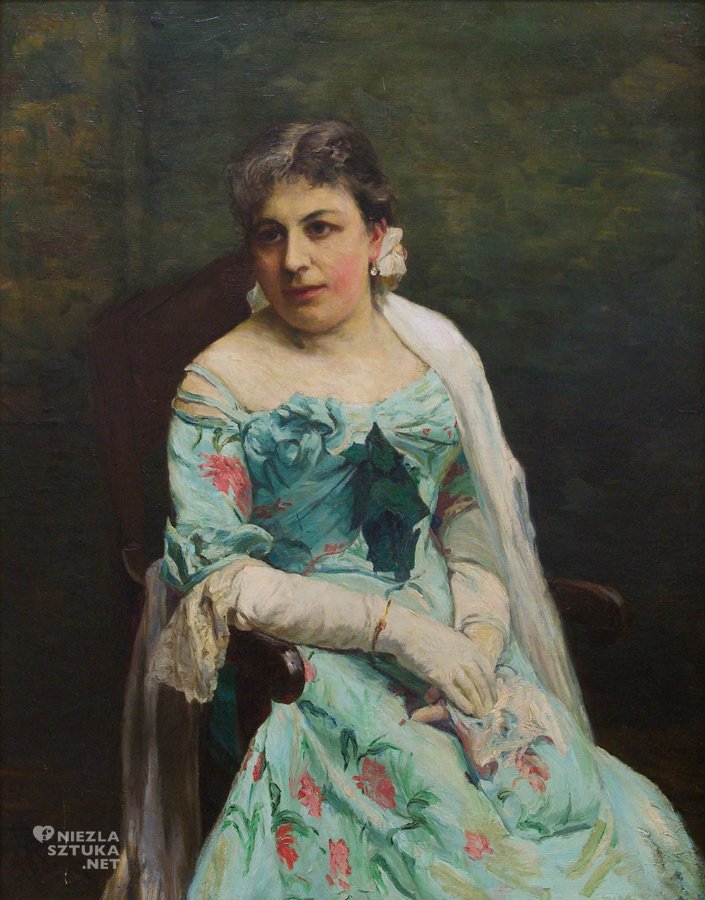
JADWIGA BOGUSŁAWA WIERUSZ-KOWALSKA (née SZYMANOWSKA)
Wife of Alfred Wierusz-Kowalski, mother of the family’s artistic generation
Jadwiga Bogusława Wierusz-Kowalska, née Szymanowska, was the wife of Alfred Wierusz-Kowalski, one of the most outstanding Polish painters of the Munich School. Her life was centred on Munich, where the artist pursued an international career, and on the family estate of Mikorzyn in Greater Poland. She raised her children in an environment where Polish family traditions met the European art world.¹
Although the surviving studies focus primarily on her husband’s work, Jadwiga played an important role in the life of the Wierusz-Kowalski family. Her biography offers a glimpse into the private side of the famous painter’s life and into the home where the next generation of the family grew up.¹
MARRIAGE TO ALFRED WIERUSZ-KOWALSKI
On 26 February 1878, Jadwiga Bogusława Szymanowska married Alfred Jan Maksymilian Wierusz-Kowalski. The wedding took place in Warsaw, at St Anthony’s parish. The marriage certificate has survived; a reproduction of it serves as a valuable genealogical record and documents the beginning of the couple’s shared history.²
Alfred was 28 years old at the time and was already part of the burgeoning community of Polish painters in Munich. After studying in Warsaw and Dresden, he settled in the Bavarian capital, where he honed his artistic skills, under the guidance of Józef Brandt, amongst others. In the years that followed, he gained increasing recognition, and his paintings found their way into the collections of art lovers in Europe and the United States.³
Jadwiga and Alfred’s marriage thus began at a time of intense development in the artist’s career. Munich became the main centre of their family life, whilst contacts with Poland remained an important part of their daily lives.
THE FAMILY HOME IN MUNICH
Jadwiga and Alfred’s children were born in Munich, including Czesław Teofil Wierusz-Kowalski, born on 12 May 1882, and their youngest son, Jerzy, born on 10 April 1892. The family also included daughters Janina and Michalina, and son Józef.¹
A surviving photograph, taken around 1883–1884 at Otto Reitmayer’s studio in Munich, depicts the painter’s three eldest children: Janina, Michalina and Czesław. It is one of the most valuable records documenting the family’s early years.⁴
The children grew up surrounded by art. Alfred’s studio was not only where he worked every day, but also a meeting place for artists, collectors and members of the Polish community in Munich. It was in this unique environment that the interests of the young Czesław took shape; like his father, he later chose to become a painter.¹
Despite living abroad for many years, his parents took care to preserve the Polish language, maintain family ties and keep the children connected to their homeland. Being brought up in two cultural environments – Polish and German – became a defining experience for this generation of the Wierusz-Kowalski family.¹
MIKORZYN – THE FAMILY’S POLISH HOME
An important event in the couple’s life was Alfred Wierusz-Kowalski’s purchase of the Mikorzyn estate in the Konin district. On 13 July 1896, the artist purchased the estate from Wacław Sikorski for 43,000 silver roubles. The estate comprised a manor house, a park, farm buildings, arable land, forests and land situated on the shores of a lake.⁵
Mikorzyn became the family’s Polish residence. Whilst Alfred continued to work primarily in Munich, Jadwiga and the children resided at the estate, which in time became the true centre of the Wierusz-Kowalski family’s life.⁵
The palace was surrounded by a vast landscaped park, and nearby there were gardens, an orchard, farmland and farm buildings. Konrad Wierusz-Kowalski, Alfred’s youngest brother, was also involved in managing the estate; amongst other things, he developed the horse breeding operation.⁶
Mikorzyn allowed the children to experience the Polish landscape, language and customs at first hand. This proved particularly important for Czesław, who, in his later paintings, repeatedly returned to motifs of nature, landscape and horses.¹
Thanks to the presence of Jadwiga and the children, Mikorzyn was not merely a holiday retreat for the renowned artist. It remained a family home, bringing generations together and maintaining ties with Poland despite Alfred’s many years of working abroad.
PORTRAIT OF JADWIGA
Among the most valuable mementoes associated with Jadwiga is her portrait painted by Alfred Wierusz-Kowalski, now held in the collection of the Regional Museum in Suwałki.⁷
The work is of particular significance as it depicts a person from the artist’s immediate circle. Alfred, known primarily for his dynamic genre scenes, horse-drawn carriages, winter landscapes and wolf attacks, also painted portraits.
The portrait of Jadwiga bears witness to a more personal side of his work. It is also an important iconographic record of the history of the Wierusz-Kowalski family, helping to preserve the memory of a woman whose life was, for many years, closely linked to one of the most recognisable Polish artists of the second half of the 19th century.
THE FAMILY AFTER ALFRED’S DEATH
On 16 February 1915, Alfred Wierusz-Kowalski died in Munich. His death brought to an end his marriage to Jadwiga, which had lasted nearly four decades, and marked the close of an important period in the family’s history.³
Following the artist’s death, Mikorzyn was inherited by his youngest son, Jerzy. In the years that followed, the family’s financial situation underwent changes. According to Barbara Nasierowska’s memoirs, financial difficulties led to the decision to transfer the estate to Janina Wierusz-Kowalska and her husband, Tadeusz Swinarski.⁶
The family’s artistic traditions were continued by Czesław Wierusz-Kowalski, who developed his own style of painting, studied in Munich and Paris, and later played an active role in Polish artistic life. In the next generation, Joanna Wierusz-Kowalska-Turowska, the granddaughter of Alfred and Jadwiga, also took up artistic work.¹
PLACE IN THE FAMILY’S HISTORY
Jadwiga Bogusława Wierusz-Kowalska, née Szymanowska, remains one of the key figures in the history of Alfred Wierusz-Kowalski’s family. Her life unfolded between Munich and Greater Poland, amidst her husband’s artistic career and the daily responsibilities of raising children and running the family home.
The surviving documents, photographs and a portrait of Jadwiga allow us to piece together a fragment of the family’s history, whose fortunes were divided between Poland and Germany, yet whose successive generations maintained strong ties with Polish culture.
Her story also serves as a reminder of the importance of women in the history of 19th-century artistic families. Although they were often overshadowed by their more famous husbands and sons in biographical accounts, they helped shape the family environment in which successive generations flourished.
FOOTNOTES
- 1. Eliza Ptaszyńska, ‘Three Generations of the Wierusz-Kowalski Family: Styles, Eras, Countries’, *Muzealnictwo*, no. 48, Warsaw 2007, pp. 95–109.
- 2. Marriage certificate of Alfred Jan Maksymilian Wierusz-Kowalski and Jadwiga Bogusława Szymanowska, Warsaw, St Anthony’s Parish, 26 February 1878; a reproduction of which is included in the chapter devoted to Alfred Wierusz-Kowalski.
- 3. Eliza Ptaszyńska, Alfred Wierusz-Kowalski, 2nd ed., Olszanica: Wydawnictwo Bosz, 2021.
- 4. Suwałki Regional Museum, photograph of Janina, Michalina and Czesław Wierusz-Kowalski, Otto Reitmayer’s studio, Munich, circa 1883–1884.
- 5. Jacek Wojciechowski, a study of the history of the palace in Mikorzyn and its owners, used in the chapter devoted to Mikorzyn.
- 5. Barbara Nasierowska (née Swinarska), recollections concerning the family of Alfred Wierusz-Kowalski and the Mikorzyn estate, cited in the study of the family seat’s history.
- 6. The Regional Museum in Suwałki, a portrait of Jadwiga Wierusz-Kowalska (née Szymanowska), painted by Alfred Wierusz-Kowalski, from the museum’s collection.