
Maria "Tapta"
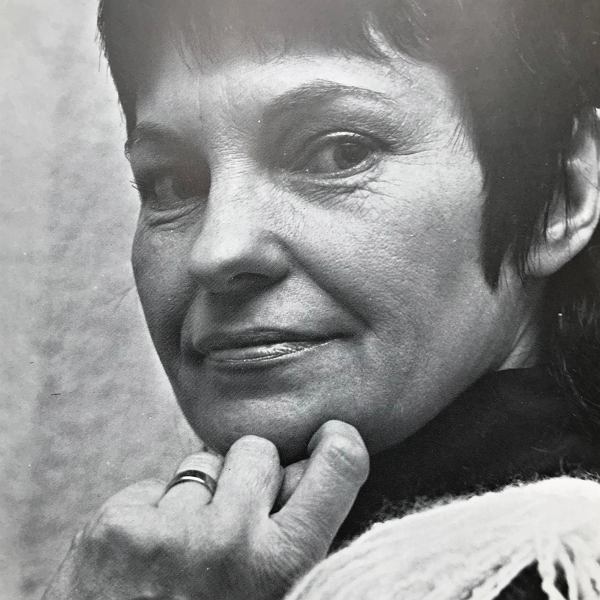
MARIA IRENA TAPTA WIERUSZ-KOWALSKA (1926–1997)
A participant in the Warsaw Uprising, an artist of international standing and a pioneer of soft sculpture
Maria Irena Boyé, later known as Maria Wierusz-Kowalska, and in the art world under the pseudonym Tapta, was one of the most original figures of the European avant-garde in the second half of the 20th century. Her life combined the dramatic experiences of the German occupation, underground resistance and the Warsaw Uprising with emigration, a stay in Africa and an international artistic career. She became famous as a pioneer of soft sculpture, creating monumental compositions from fibres, cords, ropes and industrial materials.¹
She became part of the Wierusz-Kowalski family through her marriage to Krzysztof Andrzej Wierusz-Kowalski. Her biography constitutes a separate, extremely interesting chapter in the history of the family, whose members have held an important place in Polish and European art across successive generations.
CHILDHOOD AND THE BOYÉ FAMILY
Maria was born on 7 April 1926 in Kościan as the youngest of three daughters of Władysław Boyé and Anna née Rząśnicka. Her father, a native of Warsaw born in 1894, managed the Kościan sugar factory, whilst her mother was born in 1895 in Russia. Maria’s older sisters were Krystyna and Anna. The family were active in the social and cultural life of Kościan.²
From childhood, Maria was known as Tapta. This family nickname stayed with her throughout her life and eventually became the stage name under which she achieved international fame.
Shortly before the outbreak of the Second World War, the Boyé family moved to Warsaw. Maria continued her education there, and during the German occupation she attended clandestine classes and passed her A-levels. At the same time, she became involved in underground scouting activities, leading the secret 77th Warsaw Girls’ Scout Troop.²
THE WARSAW UPRISING
In August 1944, eighteen-year-old Maria took part in the Warsaw Uprising. She served in the Medical Unit of the Warsaw District of the Home Army, in the Zaremba-Piorun battalion. She worked as a medic in a field hospital at 61 Wilcza Street, set up in a flat made available by her parents.²
Together with other Girl Guides, she looked after the wounded, delivered messages and parcels, obtained food and helped prepare meals. Work at the makeshift hospital took place under extremely difficult conditions, with growing shortages of medicines, dressings and food.
After the fall of the uprising, Maria was taken prisoner by the Germans. She was given prisoner-of-war number 298859 and remained at Stalag IV B Zeithain until the end of the war.²
Her experiences of the occupation, the uprising and captivity left a lasting mark on her life. In later years, she rarely revisited her wartime memories, focusing instead on her artistic work and building a new life outside Poland.
KRZYSZTOF ANDRZEJ WIERUSZ-KOWALSKI – TAPTA’S HUSBAND
Whilst involved in the underground resistance, Maria met Krzysztof Andrzej Wierusz-Kowalski, her future husband.
Krzysztof, born in 1922 according to genealogical records, came from the Wierusz-Kowalski family, which boasted artistic traditions stretching back several generations. In biographical accounts, Tapta is described as the grandson of Alfred Wierusz-Kowalski, an outstanding painter of the Munich School. However, the precise genealogical links to individual family members require documentary confirmation.³
During the occupation, Krzysztof was active in the underground Scout movement. During the Warsaw Uprising, he took part in the work of the Scout Field Post, as part of a team responsible for monitoring the content of correspondence being sent. His tasks included, amongst other things, preventing the disclosure of military information that could endanger the safety of the insurgents.³
The mothers of two well-known scouts also took part in the postal service’s activities: Florian Marciniak, the first leader of the Grey Ranks, and Jan Bytnar, one of the heroes of *Stones for the Rampart*.
Maria and Krzysztof thus belonged to the same generation of young Poles whose coming of age had been cut short by the war. They were united by their experiences in the underground, their scouting activities and their participation in the Warsaw Uprising. It was in these dramatic circumstances that their shared story began.³
MARRIAGE AND EMIGRATION
Maria Boyé and Krzysztof Andrzej Wierusz-Kowalski were married in 1945. After the war ended, they decided to leave Poland. They initially stayed in London, before settling in Belgium.⁴
For Maria, marriage meant joining the Wierusz-Kowalski family, known primarily for the work of Alfred Wierusz-Kowalski and the artistic endeavours of subsequent generations. She took her husband’s surname, under which she later became recognised in the art world.
In Brussels, Maria began her studies at the École Nationale Supérieure des Arts Visuels de La Cambre, one of Belgium’s leading art colleges. She trained in the fields of weaving and the visual arts, gaining knowledge of fabric construction, the properties of fibres and techniques for creating textile compositions. She graduated in 1949.⁵
Her studies marked the beginning of her independent artistic journey. Rather than confining herself to traditional decorative weaving, she became interested in the spatial possibilities of the material, its elasticity and its behaviour under tension.
TEN YEARS IN AFRICA
Krzysztof Wierusz-Kowalski was an engineer by profession. In 1950, he was offered a professional contract in the Belgian Congo, to which he travelled with his wife. The couple spent ten years in Africa, until 1960.³
This stay proved to be a turning point for Tapta’s future creative work. She came into contact with African weaving traditions, basketry and techniques for using natural fibres. She was particularly interested in weave structures, methods of joining materials and the possibilities of constructing three-dimensional forms from them.⁵
Her experiences in Africa enabled her to view fabric in a completely new light. She ceased to regard it solely as a flat decorative surface, recognising the potential to create structures that could hang freely, twist, stretch and change shape.
Their ten-year stay in the Congo was therefore not only an important stage in Maria and Krzysztof’s married life, but also a period during which the foundations of Tapta’s future artistic career were laid.
FAMILY IN BELGIUM
After returning from Africa in 1960, Maria and Krzysztof settled once again in Belgium. Brussels became their main place of residence and the centre of Tapta’s artistic activity.
Online genealogical records mention two daughters of the couple: Anna Jolanta Wierusz-Kowalska (1951–1951) and Ewa Hanna Wierusz-Kowalska (1955–1975). However, this information has not been confirmed by registry records and should be treated as requiring further verification.⁶
The private lives of Maria and Krzysztof remain far less well documented than Tapta’s artistic work. The surviving museum studies, catalogues and articles focus primarily on her creative output, her teaching activities and her experiments with new materials.
THE BIRTH OF SOFT SCULPTURE
Upon her return to Brussels, Tapta began intensive experiments with fibres, cords and ropes. In the 1960s, she gradually moved away from traditional tapestry, creating increasingly large-scale spatial compositions.
She described her works using the French term *sculpture souple*, meaning ‘soft sculpture’. These were flexible structures that hung down, stretched and changed shape under the influence of their own weight and the tension of the material.⁵
Unlike classical sculpture, made of stone, wood or bronze, Tapta’s works remained susceptible to movement and the influence of the surrounding space. Viewers could view them from various angles, observing the changing arrangements of forms, light and shadow.
Such experiments were part of the broader transformations in European art of the 1960s and 1970s, when artists began to transcend the traditional boundaries between painting, sculpture, textiles and installation.
FROM FABRIC TO NEOPRENE
In the early 1980s, Tapta made another breakthrough in her work. She began to use industrial materials, primarily black neoprene, a flexible rubber that allowed her to construct monumental forms.⁷
The new material allowed for more decisive, austere compositions. The artist continued to explore the relationships between elasticity, tension, weight and space, but her works were increasingly moving towards monumental sculpture.
One of the most significant works of this period was *Voûtes flexibles*, created between 1983 and 1985 for the Veeweyde metro station in Brussels. This monumental composition was directly integrated into the architecture of the public space.⁷
In later years, the artist also worked with concrete, metal, water and light. From the early 1990s, lighting played an increasingly significant role in her works, creating a contrast between the weight of material structures and the immateriality of light.
ARTIST AND EDUCATOR
Alongside her own creative work, Tapta developed her career as an educator. In 1975, she took charge of the tapestry studio at La Cambre in Brussels. She headed it until 1990, gradually transforming traditional weaving instruction into a modern educational programme based on experimentation with materials and space.⁵
She encouraged students to seek out artistic solutions independently, to reject established conventions and to cross the boundaries between different fields of art.
Among the artists associated with her teaching were Ann Veronica Janssens, Monica Droste and Marie-Jo Lafontaine.
Tapta’s influence on European contemporary art thus extended far beyond her own body of work. She also left behind a new way of thinking about art education, in which experimentation, creative freedom and an exploration of the properties of materials played a fundamental role.
CONNECTION TO THE WIERUSZ-KOWALSKI ARTISTIC TRADITION
Maria Tapta Wierusz-Kowalska occupies a special place in the artistic history of the Wierusz-Kowalski family. Although she joined the family through marriage, her own body of work constitutes an important and entirely distinct chapter in the family’s legacy.
Alfred Wierusz-Kowalski was a leading figure in nineteenth-century realist painting, gaining fame for his genre scenes, horse-drawn carriages and winter landscapes. His son Czesław sought more modern approaches to colour, whilst his granddaughter Joanna Wierusz-Kowalska-Turowska developed her work in France, focusing on lyrical abstraction.
Tapta represented yet another direction. Instead of traditional painting, she chose to experiment with fabric, fibres and industrial materials. Her soft sculptures and monumental compositions made of neoprene were among the innovative achievements of European art in the second half of the 20th century.⁵
Her career also illustrates the diverse creative paths taken by those associated with the Wierusz-Kowalski family. Although they belonged to different generations and worked in different circles, the search for their own artistic language remained a common thread running through their biographies.
LATE YEARS AND LEGACY
Maria Tapta Wierusz-Kowalska died suddenly on 27 December 1997 in Brussels. That same year, her work was exhibited at the Zachęta in Warsaw.⁵
For many years, she remained far less well-known in Poland than in Belgium, where her body of work occupied an important place in the history of contemporary art. It was only through subsequent exhibitions, publications and research by art historians that her work began to be rediscovered by the Polish public.
In 2021–2022, the Arton Foundation presented her works in Warsaw. Another significant event was the exhibition *Tapta: Flexible Forms* at the Susch Museum, which offered an insight into the evolution of her work from her early weaving experiments to her monumental spatial compositions.⁷
Her life constitutes a unique chapter in the history of the Wierusz-Kowalski family. From Warsaw during the Uprising, through post-war emigration, Brussels and a ten-year stay in Africa, right up to the international contemporary art scene – her biography was a story of constantly pushing boundaries.
Tapta proved that fibre, rope or rubber can become fully-fledged materials for monumental sculpture. Thanks to this, she occupies a permanent place in the history of the European avant-garde of the second half of the 20th century.
NOTES
- 1. Liesbeth Decan, Agnieszka Sosnowska (eds.), Tapta: Flexible Forms, Susch Museum, 2024; a study of the biography and artistic work of Maria Irena Boyé Wierusz-Kowalska.
- 2. ‘The Paths of Tapta’s Life’, *Wiadomości Kościańskie*, no. 41, October–December 2022; biographical information concerning the Boyé family, Maria’s childhood, her underground activities, her participation in the Warsaw Uprising and her captivity by the Germans.
- 3. Teresa Masłowska, biographical materials concerning Maria Tapta Wierusz-Kowalska, Panteon Wielkopolanek, Wielkopolska Provincial Office in Poznań; information on Krzysztof Wierusz-Kowalski, his activities in the Scout Field Post, his marriage to Maria, and his post-war emigration. Cf. VAi Archiefhub, Vlaams Architectuurinstituut, biographical note on Maria Wierusz-Kowalska.
- 4. Biographie Nationale, Royal Academy of Sciences, Letters and Fine Arts of Belgium, biographical entry on Tapta; information concerning the marriage of Maria Irena Boyé to Krzysztof Andrzej Wierusz-Kowalski in 1945.
- 5. Susch Museum, Tapta: Flexible Forms, exhibition and research materials compiled in collaboration with LUCA School of Arts; information regarding her studies at La Cambre, her stay in the Belgian Congo, the development of her artistic work and her teaching activities.
- 6. Ancestry, public family tree of Maria (Tapta) Boyé, data concerning Krzysztof Wierusz-Kowalski (1922–1995), Anna Jolanta Wierusz-Kowalska (1951–1951) and Ewa Hanna Wierusz-Kowalska (1955–1975); information requiring confirmation based on civil registry records.
- 7. The Arton Foundation, research and exhibition materials concerning Maria Tapta Wierusz-Kowalska, including exhibitions from 2021–2022; Susch Museum, ‘Tapta: Flexible Forms’, documentation of the development of her work from soft sculpture to pieces made from neoprene and industrial materials.