
Joanna Turowska
JOANNA WIERUSZ-KOWALSKA-TUROWSKA (1930–2005)
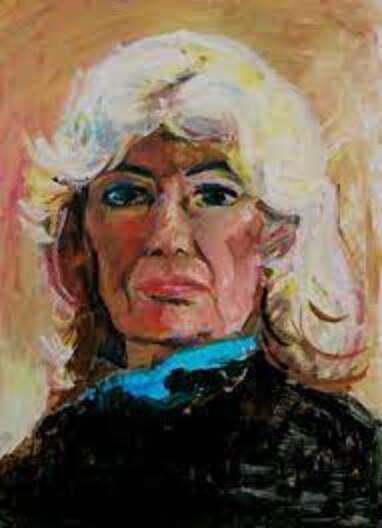
Painter, art conservator and a member of the third generation of the artistic Wierusz-Kowalski family
Joanna Wierusz-Kowalska-Turowska belonged to the third generation of the artistic Wierusz-Kowalski family. She was the granddaughter of Alfred Wierusz-Kowalski, one of the most outstanding representatives of the Polish Munich School, and the daughter of the painter Czesław Wierusz-Kowalski. Although she grew up in a family with strong artistic traditions, she consciously chose her own creative path, moving from representational painting to lyrical abstraction. After moving to Paris in 1962, she pursued an independent career in painting and art conservation, combining her Polish artistic experiences with inspirations drawn from contemporary French art.¹
CHILDHOOD AND FAMILY TRADITIONS
Joanna was born on 4 July 1930 in Vilnius, the daughter of Czesław Wierusz-Kowalski and Hanna (née Serafińska). Her father was a painter, teacher and one of the most active organisers of artistic life in interwar Vilnius. Her mother came from the Serafiński family, which had links to Koryznówka in Nowy Wiśnicz and the family circle of Jan Matejko.¹
Joanna thus grew up surrounded by several generations of painting traditions. Her grandfather Alfred gained international fame for his realistic genre scenes, depictions of horses and winter landscapes. Her father, Czesław, was already exploring other means of expression, turning towards modern colour, simplified form and more intimate compositions.
Joanna’s childhood coincided with the final years of interwar Vilnius, an important centre of Polish culture, scholarship and the arts. The Second World War and the post-war changes to borders meant that the family lost the opportunity to return to their former home. After 1945, the Wierusz-Kowalski family settled in Gdańsk, where Czesław became involved in the revival of cultural life on the coast.²
EDUCATION AND EARLY ARTISTIC EXPERIENCES
Initially, Joanna was interested in music and considered pursuing a career in the field. However, health problems forced her to discontinue her musical studies. Over time, her interests increasingly turned towards the visual arts.²
In 1950, she moved to Warsaw and began her studies at the Academy of Fine Arts. Until 1955, she studied at the Faculty of Art Conservation, including in the studio of Professor Bohdan Marconi, one of Poland’s most distinguished specialists in this field.
Her training in conservation provided her with excellent technical skills. She learnt traditional painting techniques, the properties of materials, and methods of preserving and restoring paintings. At the same time, she developed her own artistic practice, gradually seeking her own individual artistic language.²
PARIS – A NEW CHAPTER IN HER LIFE
In 1962, Joanna Wierusz-Kowalska moved permanently to Paris. At that time, the city was one of Europe’s most important centres for contemporary art, attracting artists of various nationalities representing different artistic movements.
In Montmartre, she set up a studio in the tenement building where André Breton, one of the leading figures of Surrealism, lived. She also opened her own painting conservation studio. Her professional work ensured her financial independence, enabling her to develop her art without having to subordinate it to the demands of galleries or the art market.²
In Paris, she became part of the Polish artistic and literary circle. She maintained contacts with, amongst others, Jan Lebenstein, Józef Czapski, Włodzimierz Odojewski and Andrzej Dobosz. She also met representatives of the international avant-garde, including André Breton and Salvador Dalí.³
In 1964, she employed Arika Madeyska, a Polish painter who was then settling into life in France, in her conservation studio. She helped her during the early stages of her life in exile, enabling her to find professional work and establish contacts within the artistic community.⁴
Joanna’s personal life was also closely linked to Paris. Her husband was Jerzy Turowski. Their son Marek, in later years, worked alongside his father to preserve and promote the artist’s body of work.³
FROM REALISM TO LYRICAL ABSTRACTION
Joanna Wierusz-Kowalska-Turowska’s work evolved towards an ever-greater independence from the depiction of reality. Initially, she created figurative paintings; however, she gradually began to limit recognisable forms, focusing on colour, light and the interplay of planes.
Ultimately, she developed her own language of lyrical abstraction, based on subtle colour combinations, compositional harmony and an atmosphere of contemplation. Her paintings did not tell stories in the manner characteristic of her grandfather Alfred’s paintings. Rather, they were an attempt to express emotions, memories and experiences through colour.³
Light held particular significance for her. Joanna’s paintings featured luminous spaces, illuminated planes and interpenetrating colour schemes. Her compositions often evoked associations with landscapes, vegetation or reflections of light, though they did not depict them literally.
Nature continued to be her source of inspiration. Her childhood memories of the Vilnius region, the light of north-eastern landscapes, vegetation and her travel experiences remained important to her. She transformed all these elements into her own personal painterly language.³
ARTISTIC INDEPENDENCE
Joanna Wierusz-Kowalska-Turowska did not seek publicity at any cost. Although she knew many prominent figures in the Polish and French art worlds, she maintained a distance from the fashions of the art scene and the expectations of the market.
The financial independence afforded by her work as a conservator allowed her to make her own artistic decisions. She was able to work at her own pace and develop her painting in accordance with her personal convictions.²
Her body of work is an example of art in which the experience of traditional painting techniques has been combined with a modern sensibility. Her interest in the structure of the painting, the properties of pigments and the effects of light stemmed both from her training as a conservator and from her artistic explorations.
EXHIBITIONS AND RECEPTION OF HER WORK
Joanna Wierusz-Kowalska-Turowska’s paintings have been exhibited in Poland and France. A significant event was the exhibition *Joanna Wierusz. Unknown Paintings*, organised in late January and early February 1997 at the Kordegarda Gallery in Warsaw.¹
In the catalogue for this exhibition, Mariusz Hermansdorfer published an essay entitled ‘Luminous Circles’, devoted to the nature of her work. He highlighted the role of light, colour and the spiritual dimension of the paintings, which defied simple stylistic classification.¹
Joanna’s work also became the subject of research by the art historian Jan Wiktor Sienkiewicz. In his article *French Light, Lithuanian Soil: On the Painting of Joanna Wierusz-Kowalska-Turowska*, published in 2012, he presented her body of work in the context of Polish émigré art and the experiences she gained in her native Vilnius.³
Her paintings are also held in the collection of the Regional Museum in Suwałki, an institution that has rendered outstanding service to documenting the history and creative output of successive generations of the Wierusz-Kowalski family.
THE LEGACY OF THREE GENERATIONS
Joanna Wierusz-Kowalska-Turowska died in 2005. She left behind a body of work that stands as an important example of the creative output of Polish artists working in France during the second half of the 20th century.
Her story is particularly fascinating against the backdrop of three generations of painters in the Wierusz-Kowalski family. Her grandfather Alfred represented the realistic painting of the Munich School; her father Czesław turned to modern approaches to colour; whilst Joanna found her own path in lyrical abstraction.
Each of these generations created under different historical and artistic conditions. Alfred gained recognition in late 19th-century Europe, Czesław helped build the cultural institutions of a reborn Poland, whilst Joanna developed her art within the international milieu of post-war Paris.
Despite their stylistic differences, their work was united by a devotion to painting, a respect for artistic craftsmanship, and a search for individual means of expression.
Joanna was not merely the granddaughter of the famous Alfred. She became an artist in her own right, whose paintings constitute a distinct and recognisable chapter in the history of the Wierusz-Kowalski family and of Polish émigré art.
NOTES
- 1. Mariusz Hermansdorfer, ‘Luminous Circles’, in: Joanna Wierusz. Unknown Paintings, exhibition catalogue, Kordegarda Gallery, Warsaw, January–February 1997, pp. 4–5; text also published in: Joanna Wierusz. Paintings, Wrocław 2007, p. 5.
- 2. Jan W. Sienkiewicz, ‘French Light, Lithuanian Soil. On the Painting of Joanna Wierusz-Kowalska-Turowska, Emigration Archive. Studies – Sketches – Documents, 2012, vol. 1–2 (16–17), pp. 176–177.
- 3. Jan W. Sienkiewicz, ‘French Light, Lithuanian Soil’. On the painting of Joanna Wierusz-Kowalska-Turowska, Emigration Archive. Studies – Sketches – Documents, 2012, vol. 1–2 (16–17), pp. 175–182.
- Ibid., p. 177. Information concerning Arika Madeyska’s employment in Joanna Wierusz-Kowalska’s conservation studio in Paris in 1964 and the artist’s contacts with the Polish émigré community.