
Teofil and Teofila Siewierski – Alfred’s parents
TEOFIL JÓZEF WIERUSZ-KOWALSKI (1814–1889)
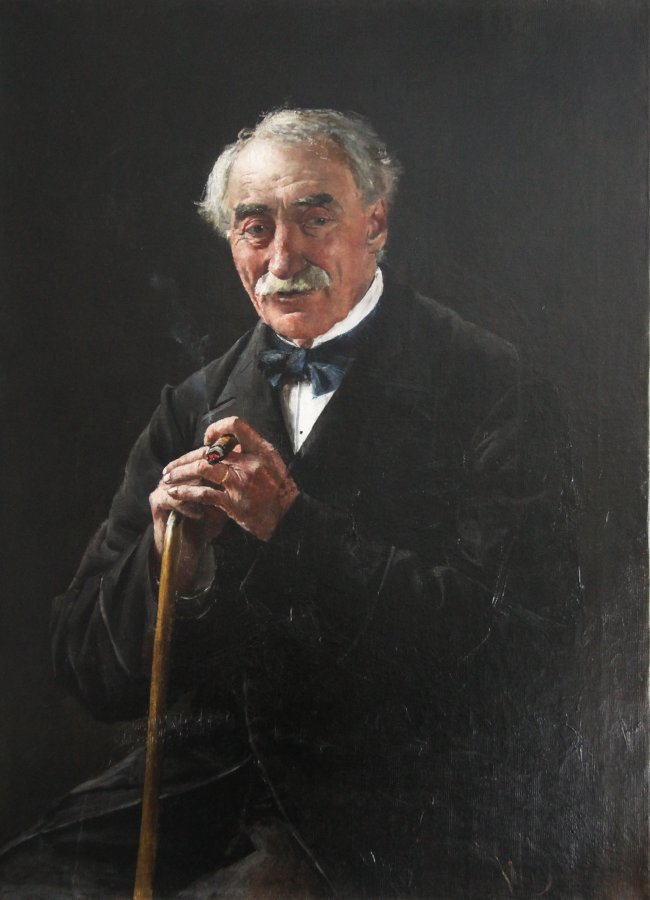
Lawyer, notary and father of Alfred Wierusz-Kowalski
Teofil Józef Wierusz-Kowalski was one of the members of his family who devoted their professional careers to the administration and judiciary of the Kingdom of Poland in the 19th century. He was a lawyer, registrar and notary, as well as the father of Alfred Wierusz-Kowalski, one of the most outstanding Polish painters of the Munich School.¹
He came from a noble family bearing the Wieruszowa coat of arms, whose roots lay in the Wieluń region. He was born in 1814, in the period leading up to the establishment of the Kingdom of Poland. His adult life spanned the era of the Partitions, the November and January Uprisings, and the social transformations taking place in nineteenth-century Poland.
FAMILY LIFE
Teofil Wierusz-Kowalski was married twice. In 1848, in the parish of Chojne, he married Teofila Antonina née Siewierska of the Ogończyk coat of arms, born on 10 April 1827 in Młodawin, the daughter of Mateusz Siewierski and Joanna Katarzyna, née Tymieniecka. For Teofil, this was his second marriage.²
On 11 October 1849, their son Alfred Jan Maksymilian Wierusz-Kowalski was born in Suwałki. He was the first child from Teofil’s second marriage. The family grew in the following years, and the Wierusz-Kowalski household became the home where their numerous children were brought up.³
SUWAŁKI AND DĘBSZCZYZNA
For many years, Teofil Wierusz-Kowalski was professionally based in Suwałki, where he worked as a lawyer and notary. The family held a prominent position in the local community and were among the town’s more affluent residents.¹
In 1856, Teofil’s wife purchased a townhouse in Suwałki, becoming its owner. The Wierusz-Kowalskis also owned a small estate called Dębszczyzna near Filipów, where they would spend the summer months.⁴
Alfred’s childhood was thus spent between their town house in Suwałki and the rural surroundings of Dębszczyzna. The landscape of north-eastern Poland – the vast fields, forests, horses and the daily life of the villagers – left a lasting impression on his imagination. Years later, it was precisely these motifs that formed the basis of his paintings, which brought him European fame.³
THE MOVE TO KALISZ
In 1865, Teofil Wierusz-Kowalski took up the post of notary in Kalisz. The change of workplace meant that the whole family had to move, bringing to an end their long stay in Suwałki.⁵
Alfred was sixteen at the time. In Kalisz, he continued his education at a classical secondary school and developed an interest in drawing. He soon began his artistic training, which took him to Warsaw, Dresden, Prague and, ultimately, Munich.³
The move to Kalisz was therefore a significant moment not only in Teofil’s professional life, but also in the life of his most famous son.
FAMILY HERITAGE
Teofil Józef Wierusz-Kowalski represented a generation of the Polish nobility who, under the conditions of the Partitions, combined family traditions with education and professional work. As a lawyer and notary, he belonged to the civil service and intellectual circles of the Kingdom of Poland.
His son Alfred gained international fame as a painter, and subsequent generations of the Wierusz-Kowalski family continued the family’s artistic traditions. Among his descendants were, amongst others, the painter Czesław Wierusz-Kowalski and the painter Joanna Wierusz-Kowalska-Turowska.³
The Regional Museum in Suwałki holds a portrait of Teofil Wierusz-Kowalski, which is a valuable family heirloom. Together with the portrait of his wife, Teofila née Siewierska, it serves as a reminder of the generation in whose home the future master of Polish painting was brought up.⁶
FOOTNOTES
- 1. State Archives in Suwałki, collection no. 255, Office of Teofil Wierusz-Kowalski, notary in Suwałki, 1839–1865.
- 2. Genealogical materials concerning the Siewierski family of the Ogończyk coat of arms and the marriage of Teofil Wierusz-Kowalski and Teofila Antonina Siewierska, contracted in 1848 in the parish of Chojne.
- 3. Eliza Ptaszyńska, Alfred Wierusz-Kowalski, 2nd ed., Olszanica: Bosz Publishing House, 2021.
- 4. DwuTygodnik Suwalski, no. 9, 2015, a study of the history of the Suwałki townhouse belonging to Teofila Wierusz-Kowalska.
- 5. State Archives in Kalisz, collection no. 11/106/0, Notary Teofil Kowalski in Kalisz, 1865–1876.
- 6. Suwałki Regional Museum, iconographic collections relating to the family of Alfred Wierusz-Kowalski, portraits of Teofil and Teofila Wierusz-Kowalska.
TEOFILA ANTONINA WIERUSZ-KOWALSKA (née Siewierska) (b. 1827)
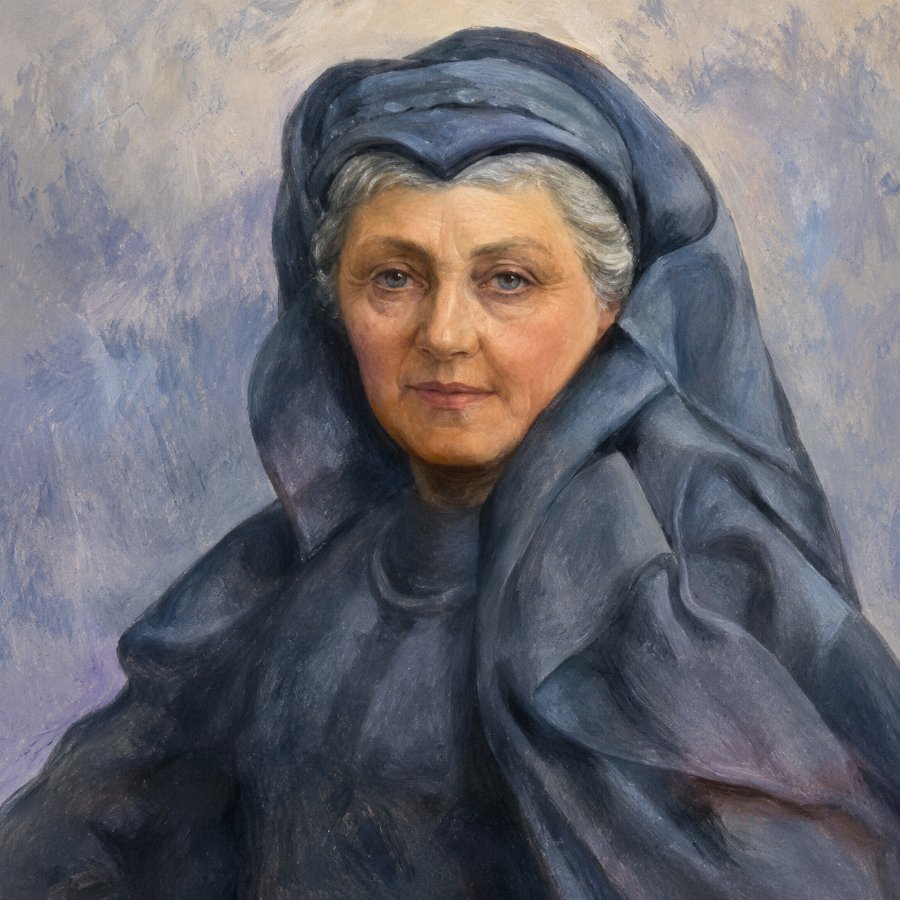
Wife of Teofil Wierusz-Kowalski and mother of Alfred
Teofila Antonina née Siewierska Wierusz-Kowalska belonged to a generation of women from Polish landowning families whose lives spanned the period of the Partitions and the social upheavals of the nineteenth century. She was the wife of Teofil Józef Wierusz-Kowalski, a lawyer and notary, and the mother of Alfred Wierusz-Kowalski, one of the most outstanding Polish painters of the Munich School. Although in historical accounts she remains in the shadow of her famous son, the surviving genealogical records, documents relating to the family’s estates and a portrait allow us to reconstruct the most significant events of her life.¹
ORIGINS AND FAMILY
Teofila Antonina Siewierska was born on 10 April 1827 in Młodawina, in the Sieradz region. She came from the Siewierski family of the Ogończyk coat of arms. She was the daughter of Mateusz Siewierski, owner of the Chojne estate and holder of the Złoczew estates, and Joanna Katarzyna née Tymieniecka of the Zaremba coat of arms.²
She was brought up in a landed gentry environment, where family ties, noble traditions and the management of landed estates played a significant role. The Siewierski and Tymieniecki families belonged to the circle of nobility associated with the Sieradz region.
In 1848, in the parish of Chojne, Teofila married Teofil Józef Wierusz-Kowalski of the Wieruszowa coat of arms, born in 1814. This was her husband’s second marriage. Teofil was about thirteen years her senior and worked as a lawyer, and later as a solicitor and notary.²
FAMILY LIFE IN SUWAŁKI
After her marriage, Teofila made Suwałki her home, where her husband carried out his professional activities. The Wierusz-Kowalski family belonged to the well-to-do circles of the local civil service and landed gentry.³
On 11 October 1849, their son Alfred Jan Maksymilian Wierusz-Kowalski was born in Suwałki; he later became a painter whose works brought him international fame. He was the first child from Teofila’s second marriage. The family grew in the following years, and Teofila devoted herself to bringing up her numerous children.¹
The Wierusz-Kowalski household was connected with both urban life and the rural surroundings of the Suwałki region. The family owned a small estate, Dębszczyzna, near Filipów, where they spent the summer months. Vast fields, forests, sandy roads, horses and the lives of the local people formed the landscape of Alfred’s childhood.¹
It was precisely these images of the Polish countryside that later reappeared in his paintings. Although he lived and worked in Munich for most of his adult life, the landscapes and scenes he remembered from his homeland remained one of the most important sources of inspiration for his work.
THE OWNER OF THE TENEMENT HOUSE IN SUWAŁKI
The history of the family tenement house in Suwałki provides significant evidence of Teofila’s financial independence. In 1856, she purchased half of the property from the widow of Fryderyk Katzke, whilst she acquired the other half following an auction held after legal proceedings. In this way, she became the owner of the entire property.⁴
The purchase of the tenement house represented a significant investment and confirmed the family’s stable financial position. The Wierusz-Kowalski family lived there until 1865, when they moved to Kalisz. Teofila, however, retained ownership of the property for several more years. It was not until 1873 that she sold it to the lawyer Aleksander Szymański.⁴
The documents relating to this transaction are among the most fascinating accounts of her life. They portray Teofila not only as the wife of a civil servant and the mother of a future artist, but also as someone who acted independently in financial matters.
THE MOVE TO KALISZ
In 1865, Teofil Józef Wierusz-Kowalski took up the post of notary in Kalisz. Her husband’s change of employment led to the whole family moving house and brought to an end their stay of over a decade in Suwałki.⁵
Alfred was sixteen at the time. In Kalisz, he continued his education at a classical grammar school and developed his talent for drawing under the guidance of Stanisław Barcikowski. Previously, he had also taken lessons from Kazimierz Górnicki. The young Wierusz-Kowalski’s artistic interests gradually evolved into a conscious choice of his future profession.¹
A few years later, Alfred began studying at the Drawing Class in Warsaw, before travelling to Dresden, Prague and Munich. Whilst his career flourished abroad, his homeland and childhood memories remained a constant presence in his work.
PORTRAIT OF TEOFILA
One of the most precious mementoes associated with Teofila Wierusz-Kowalska is her portrait, preserved in the collection of the Regional Museum in Suwałki. The portrait depicts a woman in dark clothing and a blue headdress.⁶
The portrait forms part of the iconographic material documenting the history of Alfred Wierusz-Kowalski’s immediate family. The Suwałki museum’s collection also includes a portrait of her husband, Teofil Józef Wierusz-Kowalski.
Both portraits are of particular value, as they provide an insight into the appearance of the artist’s parents and serve as a tangible record of the family environment in which he spent his childhood. They also form an important complement to the genealogical records and information preserved in studies concerning his life.
A PLACE IN FAMILY HISTORY
Teofila Antonina née Siewierska Wierusz-Kowalska united two noble families with traditions stretching back many generations: the Siewierski family of the Ogończyk coat of arms and the Wierusz-Kowalski family of the Wieruszowa coat of arms. Her life was primarily linked to Suwałki and Kalisz, towns which played an important role in Alfred’s childhood and youth.
Preserved documents relating to the tenement house in Suwałki, genealogical information and a portrait depict her as a representative of the nineteenth-century landed gentry, whose story extends beyond the mere fact of her kinship with the famous painter.
She remains an important link in the history of the Wierusz-Kowalski family. Thanks to the surviving sources, we can recall this woman who raised the future master of the Munich School and whose life forms part of the family’s history in the 19th century.
FOOTNOTES
- 1. Eliza Ptaszyńska, Alfred Wierusz-Kowalski, 2nd ed., Olszanica: Wydawnictwo Bosz, 2021.
- 2. Genealogical study of the Siewierski family of the Ogończyk coat of arms; details concerning Teofila Antonina Siewierska, born on 10 April 1827 in Młodawina, daughter of Mateusz Siewierski and Joanna Katarzyna née Tymieniecka; information regarding her marriage to Teofil Józef Wierusz-Kowalski in 1848 in the parish of Chojne.
- 3. State Archives in Suwałki, collection no. 255, Office of Teofil Wierusz-Kowalski, notary in Suwałki, 1839–1865.
- 4. DwuTygodnik Suwalski, no. 9, 2015, a study of the history of the townhouse belonging to Teofila Wierusz-Kowalska, covering the purchase of the property in 1856 and its sale to Aleksander Szymański in 1873.
- 5. State Archives in Kalisz, collection no. 11/106/0, Notary Teofil Kowalski in Kalisz, 1865–1876.
- 6. Regional Museum in Suwałki, iconographic collections relating to the family of Alfred Wierusz-Kowalski, portraits of Teofila née Siewierska and Teofil Józef Wierusz-Kowalski.